


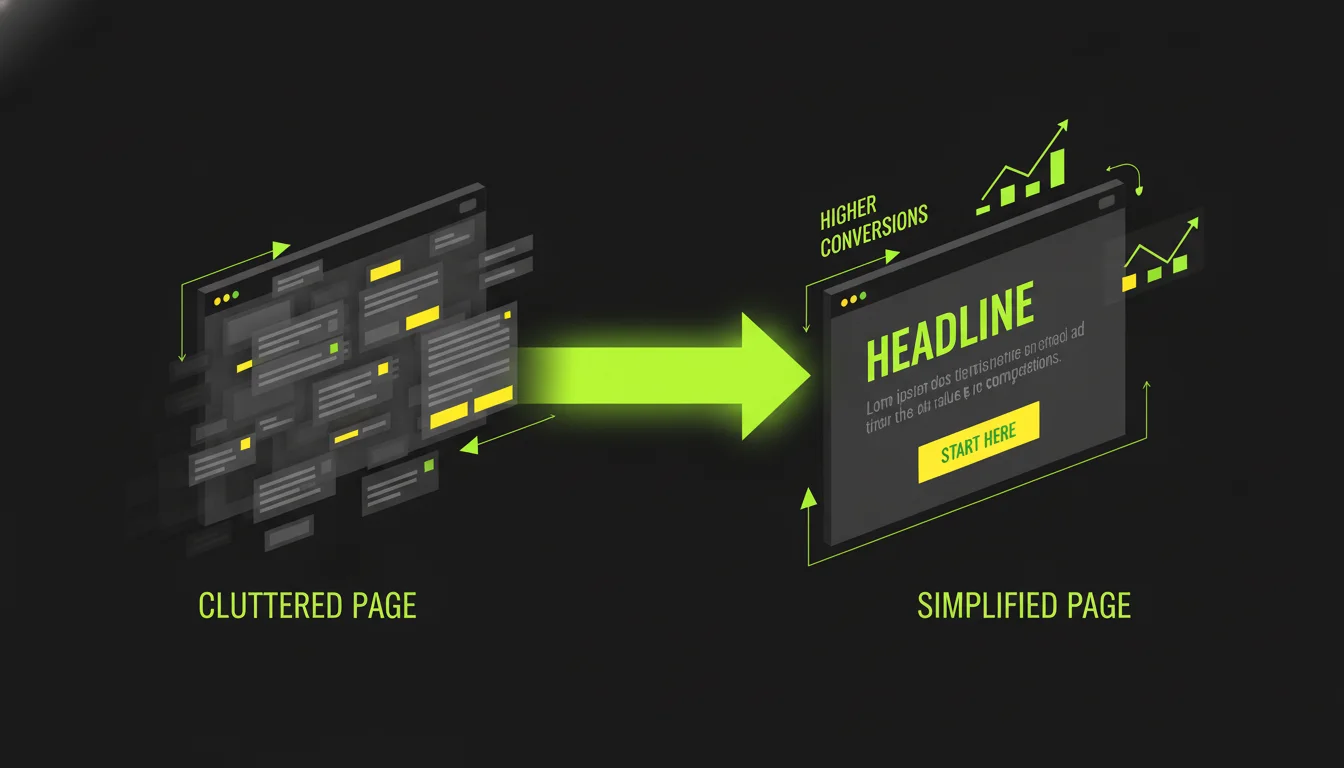
By October 2025, a shocking trend emerged: award-winning ad campaigns weren’t converting. Meanwhile, “boring” brands with crystal-clear messaging were stealing market share, doubling CAC efficiency, and building unbreakable moats. The data is sobering: 68% of consumers avoid brands they don’t understand. Clarity drives 4.2x higher conversions than creativity. One multinational brand tested its award-winning campaign against a simplified version—the “boring” one drove 340% more conversions.
This isn’t anti-creativity. It’s clarity-first thinking. In 2026, the most successful brands won’t be the most creative. They’ll be the most understood.
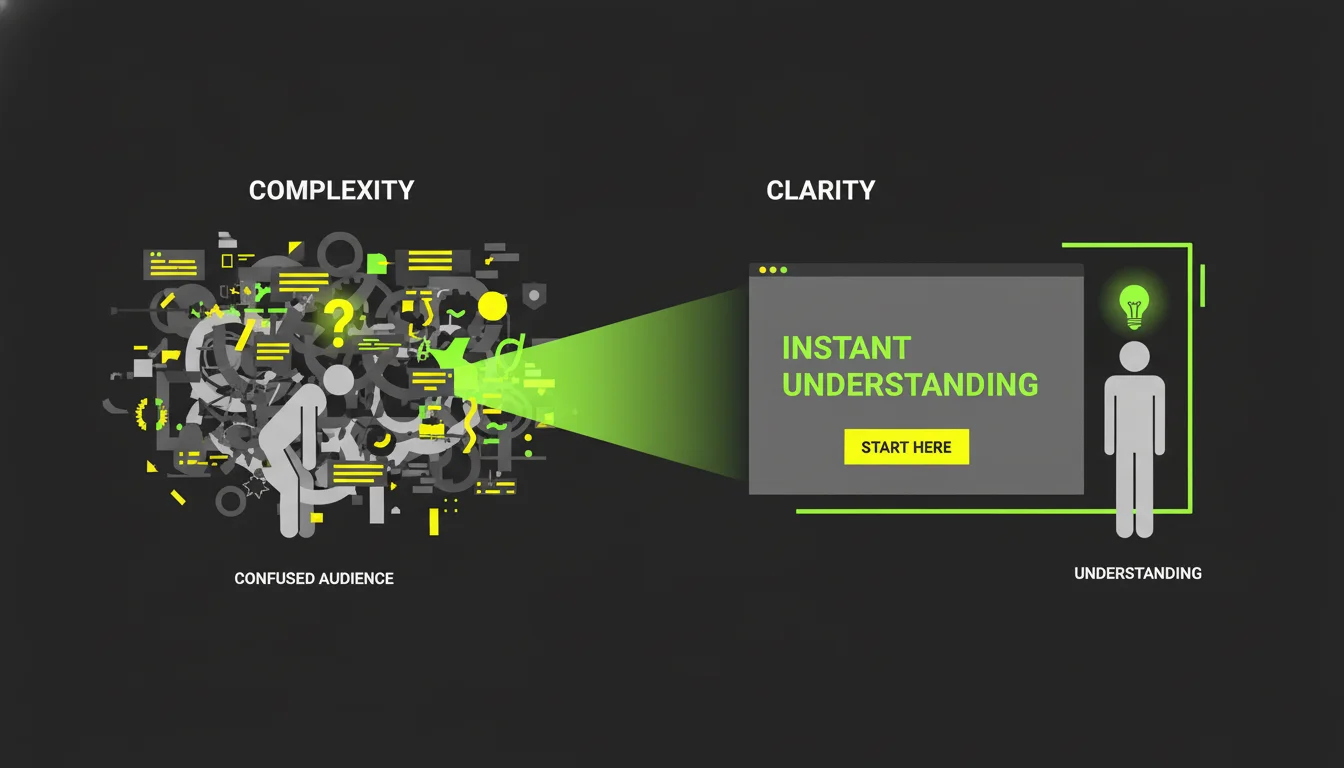
The Neuroscience: Why Confusion Kills Conversions
Every moment, your brain asks three questions: Is this for me? Can I understand it in 5 seconds? Is it worth my attention? If any answer is “no,” your brain discards the message.
Cognitive load theory explains why. Your working memory holds only 5–9 pieces of information. Messages exceeding this threshold create cognitive dissonance—friction, not delight. A stunning campaign requiring three viewings loses 93% of its audience after the first scroll.
Clear messages process 5x faster. Simple language (8th-grade reading level) converts 2.3x higher. Direct value statements eliminate 67% of customer confusion at buying moments.
Clarity removes friction. Every word should answer one question: What do you offer, and why should I care?
The Four Pillars of Clarity-First Messaging
Pillar 1: One Core Message
Write it in one sentence: “We solve X for Y using Z.” Dollar Shave Club didn’t explain supply chains. They said, “Our blades are f***ing great.” That clarity cut through 50 years of Gillette’s complexity.
Pillar 2: Specificity Over Abstraction
“We help you grow” is invisible. “We help SaaS founders reduce CAC by 40% in 90 days” stops the scroll. As explored in branding vs marketing strategies, brands defining themselves through specific outcomes outperform vague ones 3.1x on conversions.
Pillar 3: Simplicity Over Sophistication
“Leverage synergistic paradigm shifts” sounds smart. “We help you make more money” converts. Plain English wins. Write like you’re explaining to a smart friend, not impressing a boardroom.
Pillar 4: Reduce Friction in Design
A SaaS brand removed 12 form fields, keeping only “Book a demo.” Conversions jumped 52%. Clarity includes UX simplicity.
The Four-Week Implementation
Week 1: Write your core message. Test with 10 customers. If 8+ understand it immediately, you’re clear.
Week 2: Build three supporting claims: Why you (credibility), Why now (urgency), Why this way (differentiation).
Week 3: Delete everything that doesn’t reinforce your core message. No clever metaphors. No features. Only clarity.
Week 4: A/B test clarity variations. Measure time to understand (heatmaps), confusion rate (interviews), and conversions (analytics).
Track clarity through: Clarity score (% understanding in 10 seconds), Confusion rate (support tickets asking “what do you do?”), Time to comprehension (eye-tracking), Conversion velocity (landing to purchase).
Use tools like Hemingway Editor, UsabilityHub, Hotjar, and Google Analytics 4.
Why This Matters
When exploring AI transforming creative agencies, you’ll notice AI-generated creative often lacks clarity. The solution? Humans write for clarity; AI optimizes it.
Clarity builds trust. Stripe’s homepage explains its value in eight words. Tesla’s is visual simplicity. These brands didn’t win through artistry—they won through relentless clarity.
Conclusion
The most impactful marketing of 2026 isn’t the most creative. It’s the clearest. Design serves clarity, not the reverse. Your job isn’t to impress—it’s to be understood in under 10 seconds.
Clarity is creativity. Simplicity is sophistication. Understanding is the ultimate conversion mechanic.
Garage Collective helps brands simplify messaging, eliminate confusion, and build clarity-first campaigns that convert because they’re understood, not because they’re clever.
FAQ’S
Q1. Doesn’t simplicity make your brand forgettable?
No. Clarity makes brands unforgettable. Audiences remember brands that solve their problems clearly. They forget creative campaigns they don’t understand.
Q2. How do I test if my messaging is clear enough?
Show your homepage to 10 strangers with no context. Can they explain your value in one sentence? If not, your messaging isn’t clear enough.
Q3. Is brand storytelling dead if I focus on clarity?
No. But your story must serve clarity. Use narrative to reinforce your core message, not distract from it.
Q4. Can I be simple AND differentiated?
Yes. Clarity differentiates better than cleverness. If your competitor is vague, being crystal-clear makes you stand out.
Q5. How do I explain complex products simply?
Break down into benefits (not features), use analogies people understand, and ruthlessly cut anything that doesn’t explain why the customer needs you.
