



Digital Marketing
Picture this: A visitor lands on your website. Instead of reading marketing copy, they’re greeted by an AI agent that asks one simple question: “What are you trying to solve?”
Based on their answer, the conversation branches. No two visitors see the same path. No scrolling. No confusion. Just dialogue that feels personal, responsive, and real.
The Numbers That Matter
The performance gap between static and conversational is staggering:
3.2x higher engagement (conversational marketing vs. static pages)
2.8x faster purchase decisions (with chatbot assistance)
67% fewer support tickets (handled by AI agents)
52% higher customer satisfaction (simultaneous improvement)
245% revenue increase per visitor (one SaaS brand’s result)
One SaaS brand completely replaced their sales funnel with a conversational AI agent. Revenue per visitor jumped 245%. Not incremental. Transformational.
The Core Shift
Static pages were built on a false assumption: everyone has the same question.
Conversational AI is built on reality: everyone has different questions. And AI agents answer each one in real-time, personalized, and at scale.
By 2026, brands still using only static pages won’t be losing ground—they’ll be invisible to competitors who’ve already moved to conversational-first strategies. This isn’t an optimization. It’s existential.
Why Human Brains Prefer Conversation
The Wiring
Human brains are wired for one thing: conversation. We trust people (and increasingly, AI agents) who listen, ask questions, and respond to our specific needs. We don’t trust monologues.
Static copy is a monologue. Conversation is dialogue. Dialogue wins every time.
Two Different Brain Modes
Reading mode: When you scan sales copy, your brain enters analytical mode. You’re evaluating claims, comparing features, building objections in real time. Your defenses are up. Your skepticism is active.
Conversation mode: When you engage in dialogue, something shifts. Your brain moves into problem-solving mode. You’re not defending—you’re discovering. You’re honest. You’re open. Friction disappears.
AI agents trigger conversation mode. They don’t broadcast. They listen. They ask. They respond to what you actually need.
Proof: The 23% vs. 64% Experiment
A productivity app ran a clean test: static landing page vs. conversational AI agent. Same product. Same audience. Same offer.
Static landing page: 23% conversion rate
AI agent: 64% conversion rate
The difference wasn’t the product. It wasn’t the price. It was the format. The AI agent made every visitor feel like they were having a personalized sales conversation—not reading marketing copy.
That’s a 178% conversion lift from changing the interaction model.
The Four Pillars of Conversational Marketing
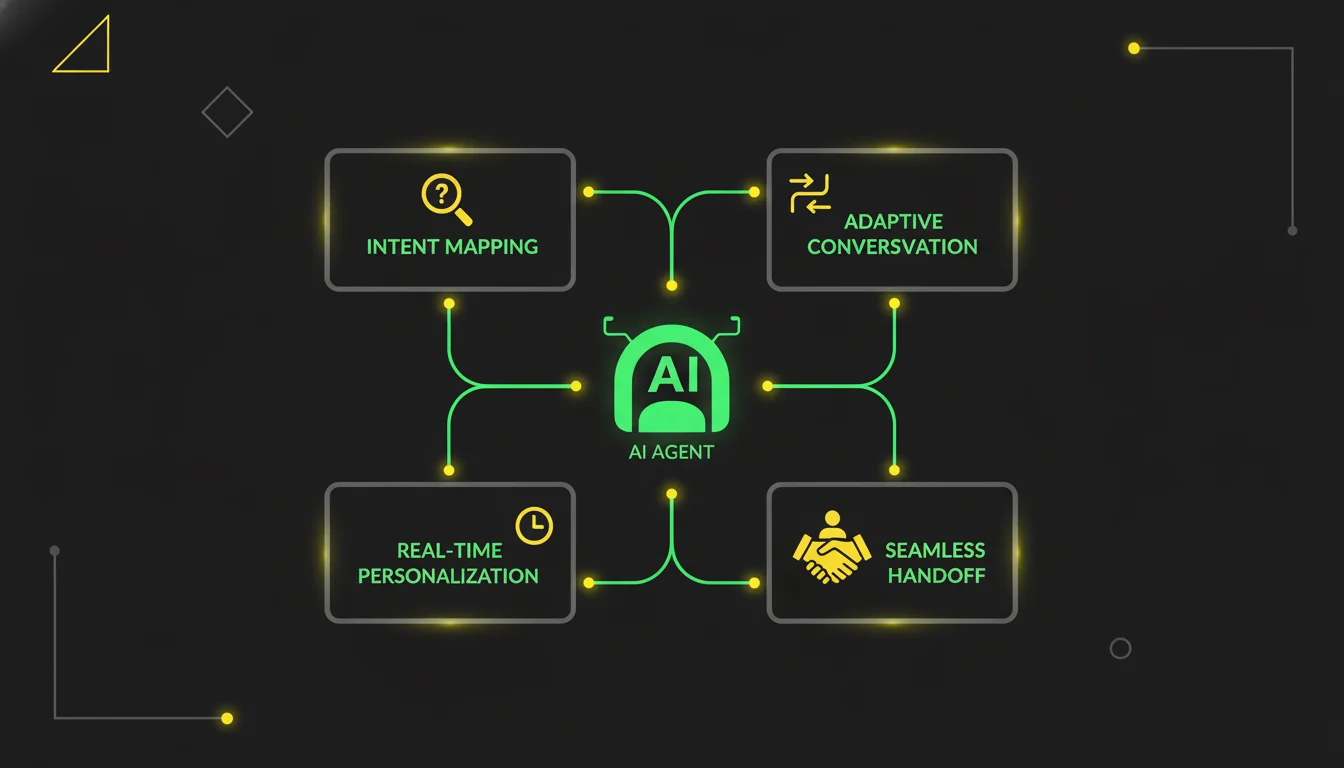
Pillar 1: Intent Mapping
The Problem: Static pages guess what visitors want. They spray a message and hope it sticks.
The Solution: Conversational AI listens. Within 20 seconds, it asks clarifying questions:
“Are you trying to reduce costs?”
“Increase productivity?”
“Solve a specific problem?”
Based on the answer, the entire conversation tree branches into personalized paths.
Real-world result: One brand built an AI agent with just five clarifying questions. Those five answers predicted which product was right, which pricing tier made sense, and which support level was needed. Conversion rates jumped 187%.
Why it works: Intent mapping is forensic. It reveals what your audience actually cares about—not what you think they care about.
Pillar 2: Adaptive Conversation Design
The Problem: Rigid scripts feel robotic. They break as soon as the conversation deviates.
The Solution: Adaptive design means the conversation adjusts in real-time based on responses.
If someone says “Budget is tight” → pivot to ROI-focused messaging
If someone says “I’m exploring options” → shift to educational, non-pushy content
If someone says “Tell me about pricing” → go deep on value, not features
Different customers, different needs, different conversation paths. Personalized conversation paths drive 3.4x higher qualified leads when exploring lead generation ecosystems.
Rigid scripts fail. Adaptive conversation succeeds.
Pillar 3: Real-Time Personalization
The Problem: Traditional personalization shows different content to different people. But everyone still gets the same conversation structure.
The Solution: Conversational personalization means the entire dialogue changes based on who you are.
A Fortune 500 CMO gets different questions than a startup founder. An existing customer gets different offers than a prospect. Someone visiting for the first time gets different education than someone on their fifth visit.
AI agents use real-time data to tailor every response:
Company size
Role and seniority
Past interactions
Browsing history
Engagement patterns
This isn’t creepy. It’s a service. Users report 68% higher satisfaction when the AI agent actually understands them.
Pillar 4: Seamless Handoff to Humans
The Problem: Not every conversation should stay with the AI. Some require human judgment. But most handoffs feel cold: “Your ticket has been queued.”
The Solution: Seamless handoff means the conversation never breaks. You just get a specialist.
Example: A customer asks about custom enterprise pricing. Instead of a dead end, the AI says: “Let me connect you with our enterprise specialist who can walk through your specific needs.”
No context loss. No restarting the conversation. Just a smooth transition from AI to human.
Result: 4.2x better customer experience compared to traditional ticketing systems.
Three Conversion Paths: Awareness to Advocacy
Path 1: Problem → Solution (Awareness to Consideration)
How it starts: A visitor lands with a real problem: “I’m spending 20 hours per week on administrative tasks.”
How the AI responds: “Which tasks take the most time? Scheduling? Invoicing? Reporting?”
What happens next: The customer lists their specific pain points. The AI doesn’t pitch the product catalog. It positions solutions directly against those exact problems.
No generic pitch. Pure relevance.
Conversion rate: 58%
This path converts well because it answers the customer’s real problem—not the company’s favorite feature.
Path 2: Comparison (Consideration to Decision)
How it starts: The customer is evaluating options. They’re asking: “Which tool is right for me?”
How the AI responds: “What features matter most to you? Automation? Integrations? Reporting? Budget constraints?”
What happens next: Customer selects their priorities. The AI positions the product against those decision criteria—not against competitors.
Conversion rate: 71%
This path converts better because the customer defined the terms of comparison. You’re not arguing on your ground. You’re arguing on theirs.
Path 3: Customer → Advocate (Relationship Building)
How it starts: After purchase, most brands go silent until there’s a problem.
How conversational AI is different: The conversation continues. It doesn’t stop.
What happens next: Onboarding conversations guide new customers. Educational dialogues deepen product knowledge. Support conversations solve problems before they escalate. Gradually, customers transition into advocates.
Why it matters: Conversational touchpoints build community faster than static resources when exploring community-led growth strategies.
Ongoing conversation creates ongoing engagement. Engagement creates advocacy. Advocacy creates growth.
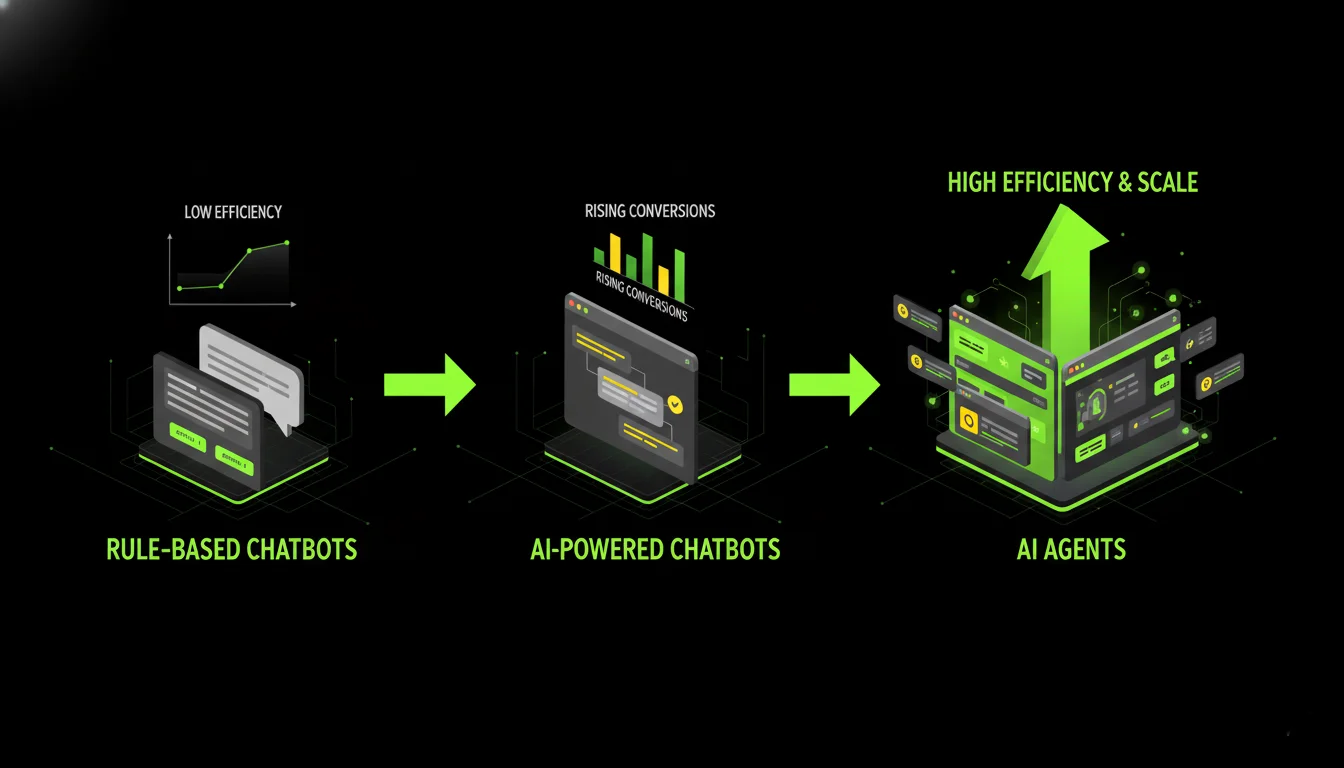
The Evolution: From Chatbots to AI Agents
Generation 1: Rule-Based Chatbots (2020–2023)
How they worked: If a customer says X, respond with Y. No nuance. No learning.
What happened: Frustration. Users abandoned after two turns. “This isn’t helpful. I want to talk to a human.”
The ceiling: Rigid, limited, frustrating.
Generation 2: AI-Powered Chatbots (2024–2025)
How they worked: Can understand intent, follow context, generate natural responses. Actually feels like conversation.
What improved: Much better. Users stick around. Satisfaction increased.
The limitation: Still mostly reactive. Handles common questions well. Struggles with novel requests or multi-step problems.
Generation 3: AI Agents (2026+)
How they work: Autonomous systems that don’t just answer—they act.
These agents can:
Qualify prospects automatically
Send follow-up sequences
Book product demos
Process transactions
Manage multi-channel conversations simultaneously
Escalate intelligently when needed
Real-world example: One brand deployed an AI agent that handled the entire customer journey. It qualified prospects, sent nurture sequences, booked demos, and processed refunds. The agent handled 73% of interactions end-to-end. The remaining 27% that required nuanced human judgment got routed to specialists. Efficiency soared.
The difference: AI agents are proactive, autonomous, and integrated with your entire business system.
Here’s the brutal truth: A chatbot that frustrates users is worse than no chatbot at all.
Conversation quality matters infinitely more than having automation. If your AI says “I don’t understand” after the customer’s third attempt, you’ve lost them. You’ve also lost their trust in your brand.
What Winners Do Differently
The brands winning in 2026 treat conversational AI like a key salesperson, not a cost-reduction tool.
They invest in conversation design:
How the AI learns and improves
How it asks clarifying questions (not interrogates)
How it acknowledges context and history
How it handles edge cases and misunderstandings
How it sounds like your brand, not a generic bot
When exploring AI transforming creative agencies, the best agencies see AI agents as brand voice—an extension of who they are—not as automation that strips personality away.
Building Your Conversational AI Stack
AI Agent Platforms (conversation infrastructure)
Intercom: Customer conversation management with AI assistance
Drift: Sales conversation automation and lead qualification
HubSpot: Full customer lifecycle conversations and CRM integration
Segment: Unify conversation data across platforms
NLP & Language Models (the brain)
OpenAI GPT: State-of-the-art conversation generation
Hugging Face: Custom NLP models for specialized domains
Rasa: Open-source conversational AI framework (full control, higher complexity)
Analytics & Measurement (proof of value)
Amplitude: Track engagement across conversation touchpoints
Mixpanel: Measure conversion paths through dialogue
Retention cohorts: Track customer lifetime value from conversational interactions
The Budget Framework
Don’t overspend on technology while neglecting design. Allocate strategically:
40% Technology
Infrastructure, platforms, language models, integrations. Build the system.
40% Conversation Design
UX, scripting, tone guidelines, brand voice training, testing. Make it feel human.
20% Analytics & Optimization
Measurement tools, A/B testing infrastructure, continuous improvement. Prove ROI.
This ratio ensures you build something that’s both sophisticated and usable.
The Conversation Is Now Your Conversion Path
By 2026, this isn’t a competitive advantage. It’s a competitive requirement.
Brands that haven’t shifted from static pages to conversational AI won’t just fall behind. They’ll lose visibility to customers who’ve moved on. Conversational marketing isn’t a feature you add. It’s the new standard.
Garage Collective helps brands architect conversational strategies from the ground up, design interactions that feel natural (not robotic), and deploy AI agents that actually drive qualified leads, accelerate conversions, and build lasting customer relationships through genuine dialogue.
Conclusion
The conversation is the new conversion path. By 2026, brands that haven’t shifted from static pages to conversational AI will find themselves unable to compete with brands who have. Conversational marketing isn’t a feature. It’s the new standard.
The question isn’t whether to deploy conversational AI. It’s whether you can afford to wait. Garage Collective helps brands architect conversational strategies, design natural interactions, and deploy AI agents that qualify leads, drive conversions, and build lasting customer relationships through genuine dialogue.
FAQ’S
Q1. Will customers accept talking to a chatbot instead of a human?
Yes, if the bot feels natural and helpful. Users prefer fast AI responses to slow human responses. When the AI hits its limits, seamless handoff to humans creates a best-of-both experience.
Q2. How do I ensure the chatbot sounds like my brand?
Train it on your existing customer interactions, tone guidelines, and brand voice samples. AI learns communication styles. Invest in conversation design, not just technology.
Q3. What percentage of conversations can AI handle end-to-end?
Well-designed conversational AI handles 60-75% of interactions completely. Another 15-25% get partially handled before human handoff. Only 5-10% require pure human judgment.
Q4. How do I measure conversational AI ROI?
Track: engagement rate (% who engage), conversion rate (% who convert from first touch), support cost reduction, and time-to-close. Conversational AI compounds across all metrics.
Q5. What’s the biggest mistake brands make with conversational AI?
Deploying it without conversation design. A poorly designed chatbot kills conversion rates. Technology matters less than dialogue quality.
