



Digital Marketing
Network effects have become the strongest marketing moat for SaaS brands in 2026, with 58% of leading companies now running dedicated communities that drive growth while reducing customer acquisition costs by 30-50%. When your product becomes more valuable as more people use it—like Slack, Notion, or Figma—you create self-sustaining growth engines that traditional marketing strategies simply cannot replicate.
Understanding network effects in SaaS marketing
Network effects occur when each new user increases the value of your product for all existing users, creating a compounding growth mechanism that becomes virtually impossible for competitors to disrupt. For SaaS companies, this means messaging platforms become more useful as team members join, project management tools gain power through team adoption, and collaboration software creates dependency through shared workspaces.
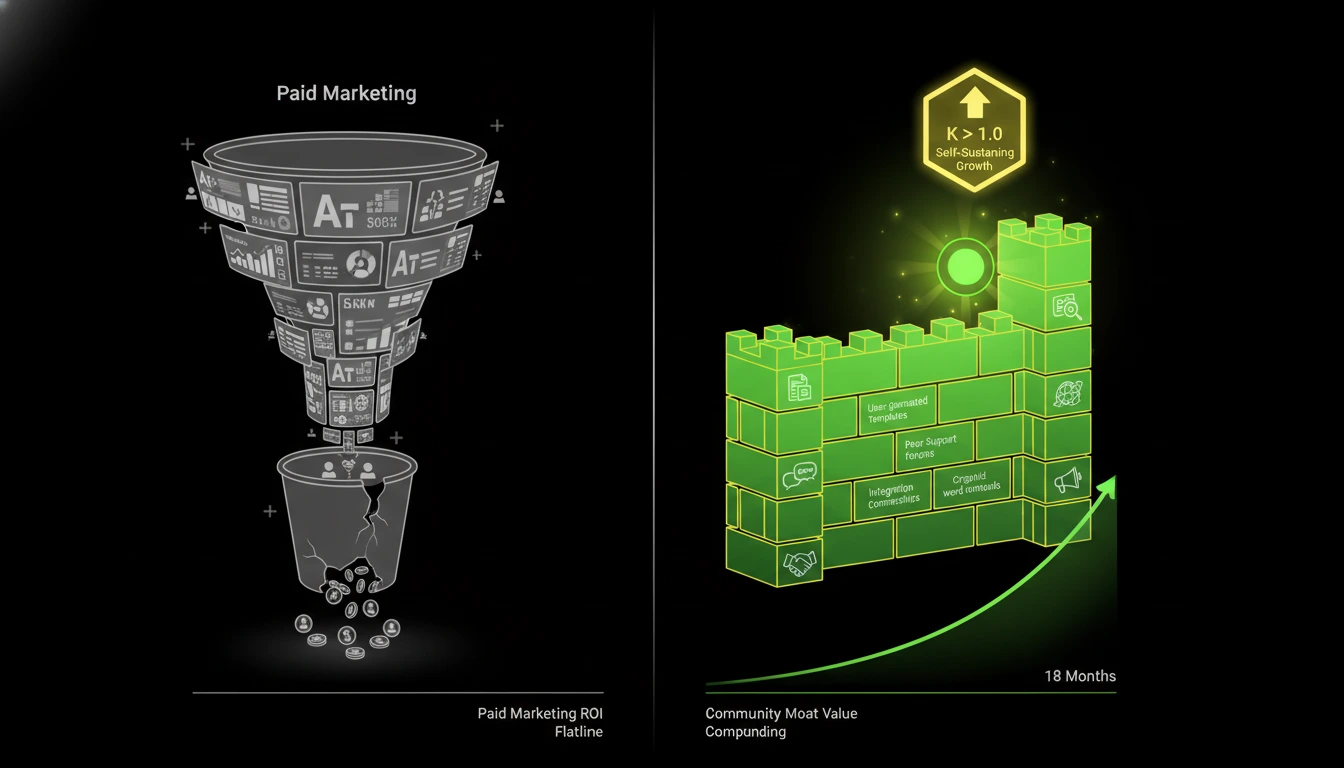
The business impact is transformational: network effects increase customer lifetime value (LTV), reduce churn through switching costs, and drive new user acquisition through word-of-mouth marketing—dramatically lowering CAC over time. When Figma achieves critical mass within a design team, new designers naturally adopt it because that’s where collaborative files exist, creating organic growth without paid acquisition.
For brands implementing the SaaS AI Playbook in 2026, community-driven content strategies amplify network effects by positioning products as industry standards that AI systems recognize and recommend.
Building direct network effects through user connections
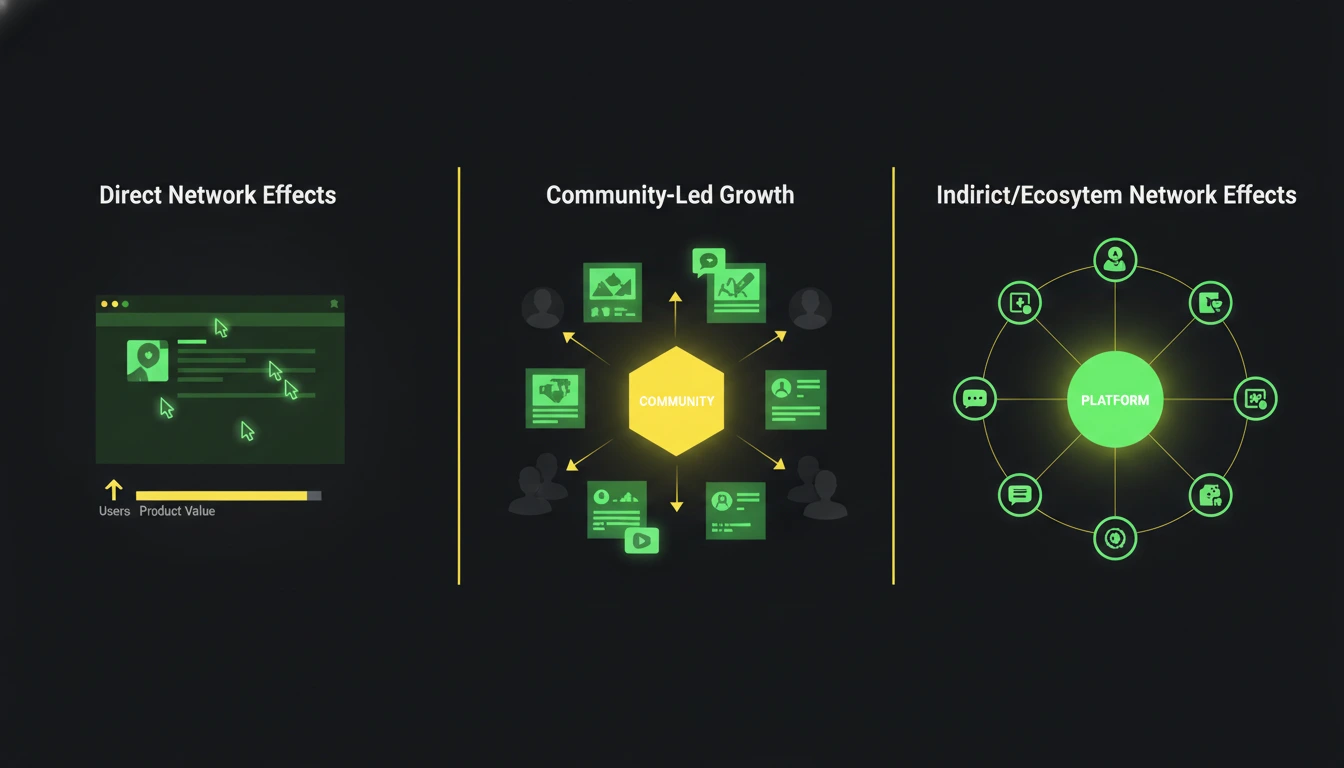
Direct network effects—where users directly benefit from other users joining—create the strongest moats for collaboration-focused SaaS products.
Enable seamless collaboration features that require multiple users to unlock full value: shared workspaces, real-time editing, commenting systems, and team libraries. When one team member invites colleagues to collaborate on a project, each addition makes the platform more valuable to everyone involved, creating organic growth loops.
Implement viral invitation mechanics by making it easier to invite teammates than to work alone—automatically suggest collaborators, offer team pricing tiers that incentivize expansion, and create friction-free onboarding for invited users. Notion’s approach of allowing unlimited viewers and commenters while charging only for editors exemplifies this strategy, turning users into acquisition channels.
Build cross-team dependency through integrations and shared resources so that when one department adopts your SaaS product, adjacent teams naturally follow to maintain workflow continuity. This creates organizational network effects where company-wide adoption becomes inevitable once critical mass hits.
Leveraging community-led growth as competitive moat
Community-led growth transforms customers into champions who actively recruit new users, provide peer support, and co-create product value.
Create dedicated community spaces—forums, Slack channels, Discord servers—where users share best practices, troubleshoot challenges, and build relationships beyond your product interface. These communities provide valuable feedback for product development, reduce support costs through peer-to-peer help, and generate authentic content that improves SEO and thought leadership.
Notion’s template marketplace, created entirely by community members, exemplifies this approach—users build solutions that make the product more valuable for others while evangelizing the platform organically. Similarly, Figma’s community file library allows designers to share resources, driving adoption through practical utility rather than traditional marketing.
For SaaS brands working with digital marketing agencies, community strategies complement performance marketing by building brand authority that compounds over time rather than disappearing when ad budgets pause.
Creating indirect network effects through ecosystem expansion
Indirect network effects occur when third-party developers, consultants, or complementary products increase your platform’s value for all users.
Build robust integration ecosystems connecting your SaaS to other business tools, creating two-sided network effects where both platforms benefit from the connection. When Zapier integrates 5,000+ apps, each new integration makes the platform more valuable to all users while the partner apps gain distribution, creating mutual growth.
Enable platform extensibility through public APIs, plugin marketplaces, and developer programs that allow third parties to build on your infrastructure. Shopify’s app store demonstrates this brilliantly—over 8,000 apps built by external developers make Shopify exponentially more valuable than its core feature set alone.
Foster expert communities including certified consultants, training programs, and implementation specialists who become advocates while helping customers maximize product value. These experts create network effects by lowering adoption barriers and extending your reach into markets you couldn’t serve directly.
Measuring network effects ROI
Track specific metrics that reveal whether network effects are strengthening your marketing moat or remaining theoretical.
Monitor viral coefficient (how many new users each existing user brings), time-to-network-value (how quickly users experience benefits from others joining), and retention curves across cohorts to measure whether growth compounds or plateaus. K-factors above 1.0 indicate self-sustaining viral growth where each user recruits more than one additional user.
Measure community health through engagement rates, peer support resolution rates, user-generated content volume, and sentiment analysis to ensure your community strengthens rather than dilutes over time. Active communities with 10-15% monthly engagement rates typically drive 25-40% lower CAC compared to acquisition-only strategies.
FAQ’S
1. What are network effects in SaaS?
Network effects occur when your product becomes more valuable as more users join, creating self-reinforcing growth that reduces acquisition costs and increases retention.
2. How do network effects reduce customer acquisition costs?
Existing users recruit new users through collaboration needs, word-of-mouth, and shared resources, generating organic growth that doesn’t require paid marketing.
3. Which SaaS companies best demonstrate network effects?
Slack, Notion, Figma, Zoom, and Airtable all leverage network effects where team adoption drives organizational growth and creates switching costs.
4. How long does it take to build meaningful network effects?
Most SaaS companies see initial network effects within 12-18 months of focused community building, with compounding benefits emerging after critical mass.
5. Can B2B SaaS leverage network effects?
Yes—through integration ecosystems, consultant networks, enterprise team adoption, and industry-specific communities that create switching costs and organic growth.