



SEO
The Search Behavior Is Fundamentally Changing
Five years ago, keyword research meant targeting three-to-four-word phrases. Today, the average search query is nearly 15 words long—and growing. This shift isn’t accidental. It’s the result of voice search adoption, AI chatbots normalizing conversational language, and users writing searches the way they speak rather than how algorithms expect. For content strategists at digital agencies, this creates both a challenge and an opportunity.
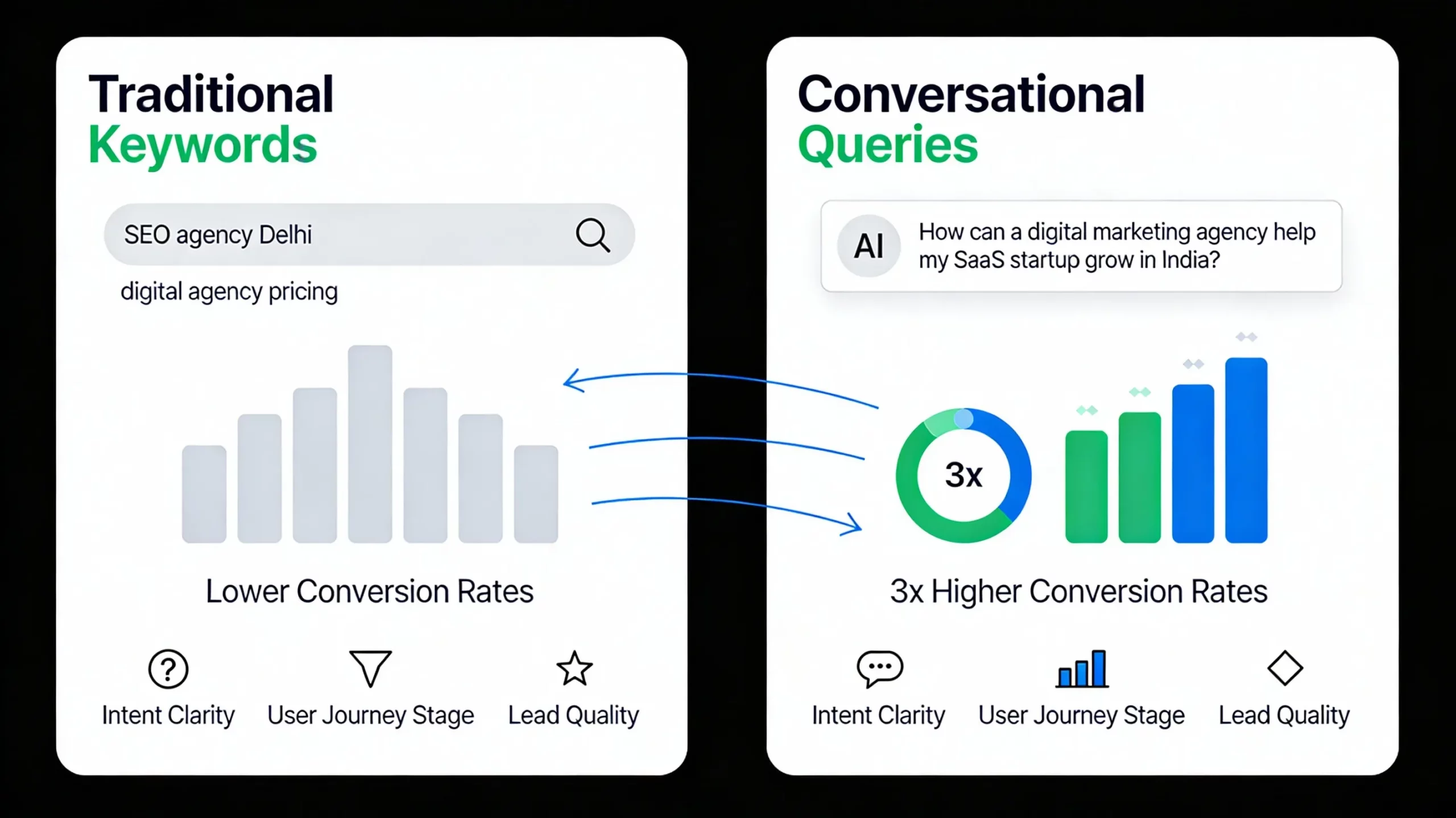
Success in 2025 demands understanding prompt-led behavior—how users phrase searches like instructions to an AI, expecting direct answers and specific results. At Garage Collective, we’ve observed that agencies adapting their keyword research to match conversational intent are capturing three times more qualified leads than those using traditional keyword tactics.
Why Conversational Queries Reveal Different Intent
Traditional keywords were transactional: “best digital agency Delhi.” But conversational queries ask full questions: “What does a creative agency do to help startups grow their online presence in Delhi?” The difference matters because conversational searches reveal user intent more clearly. A searcher asking “How can AI help with content creation?” isn’t just looking for information—they’re in research mode, considering solutions. This is a warmer lead than someone typing “AI content tools.”
When you understand this behavioral shift, your content strategy shifts too. Instead of broad, dense blog posts targeting single keywords, you build content layers that answer every question a prospect might ask. This multidimensional approach is why understanding how to optimize your website for conversions becomes critical—conversational searchers need clear pathways from question to action.
How AI Search Is Reshaping Keyword Research Fundamentals
Conversational queries often sound like prompts to ChatGPT, Claude, or Perplexity. Users now phrase searches as if they’re speaking to an AI:
- “Show me examples of how branding and marketing work together”
- “Explain the difference between content marketing and social media promotion”
- “What are the best practices for optimizing website design for conversions?”
This shift demands keyword research that captures three new dimensions. First, contextual clusters—conversational searches rarely stand alone. Instead, they appear in clusters of related questions that form a complete inquiry. For example, someone searching “What is AI-assisted content creation?” likely also asks “How does AI writing affect SEO?” and “Is AI content good for Google rankings?” Traditional keyword research tools miss these relationships. Modern research requires mapping conversation flows—the journey users take from initial questions through decision-making.
Second, intent-rich long-form keywords. Prompt-led queries explicitly state user intent. Instead of “creative agency services,” users search “Which creative agency can help us build brand awareness and generate leads through video marketing?” These longer queries (8-15 words) typically have lower search volume but significantly higher conversion rates because intent is crystalline. Users aren’t exploring—they’re comparing solutions. Understanding how to develop your brand voice through content helps you address these intent-specific queries with natural language that mirrors how prospects think.
Third, natural language patterns (NLP optimization). Google’s algorithm increasingly rewards content that matches natural language patterns—the way humans actually speak. This means your content needs to mirror conversational vocabulary, not force keywords awkwardly into sentences. A prospect might search “Can our social media marketing work better without hiring more staff?” Your content should directly address this concern with practical, language-natural solutions.
Restructuring Content for Prompt-Led Search Behavior
When writing for conversational search, structure shifts dramatically from traditional SEO best practices. Your introduction section should answer the full question immediately—don’t make readers scroll to understand what you’re addressing. Include contextual background explaining the “why” before the “how.” Conversational searchers want context and justification, not just steps.
Build information in layers: basic overview, intermediate strategies, advanced tactics. Conversational queries often reveal where in the journey users sit. Include related question sections that keep readers engaged longer and capture additional conversational variations. End with clear next steps, not vague calls-to-action.
Real Example: Applying Prompt-Led Keyword Thinking
Compare traditional versus conversational optimization:
Traditional Keyword Focus: “Content marketing strategy”
Conversational Query: “What’s an effective content marketing strategy for a B2B agency trying to attract clients without paid ads?”
The conversational query reveals the user wants strategy minus budget. It shows financial constraint (a qualifier), business model (B2B specificity), and pain point (limited paid budget). Your content should address lead generation through organic channels, building authority, and community-driven conversions.
Another example—traditional “social media marketing” versus conversational “How do we choose between social media marketing and content marketing for limited budget?” This query reveals a false dichotomy. Your content should explain how both work together, creating hybrid strategies that maximize impact on a constrained budget.
Building Keyword Clusters Around User Journeys
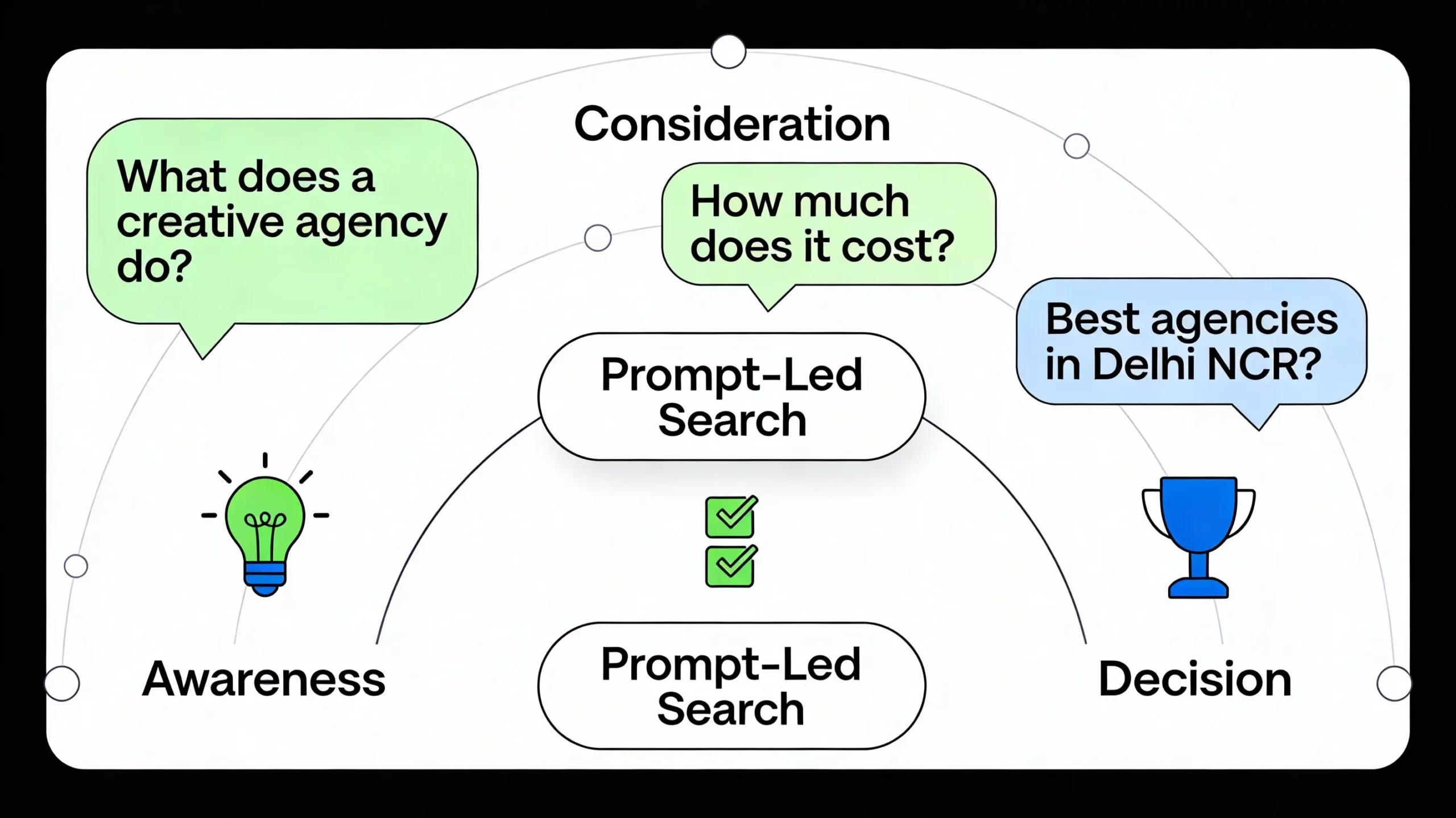
Prompt-led research reveals that users ask questions in sequences—a complete journey from awareness to decision. Map these sequences:
Awareness Phase: “What does a creative agency do?”
Consideration Phase: “How much does a creative agency cost?”
Decision Phase: “Best creative agencies in Delhi NCR”
Each phase needs different content. By mapping these conversational sequences, you create a content cluster that answers the complete customer journey. Searchers move through these stages asking different questions with different language, different intent, and different readiness to convert.
Measuring Success with Conversational Keywords
Track metrics differently for prompt-led content. Monitor average session duration (longer indicates better comprehension), pages per session (conversational content drives more exploration), conversion rate (intent-rich traffic converts higher), and time to conversion (faster decisions indicate warmer leads). Conversational keyword optimization should reduce your sales cycle significantly.
Conclusion
The search landscape is no longer about keywords—it’s about conversations. Prompt-led behavior represents how users actually think about problems, questions, and solutions. By shifting your keyword research to capture conversation flows, restructuring content for natural language, and building around full inquiries rather than single keywords, you align your agency with how search is actually evolving. Start mapping conversational clusters today, audit your content against real user questions, and watch as your organic traffic captures users earlier in their decision journey with clearer intent and higher conversion potential.
FAQ’S
Q1. What is a conversational query or prompt-led search?
A: A conversational query is a longer, natural-language search that sounds like a question you’d ask a person or AI, not a traditional keyword phrase.
Q2. Why do conversational queries have higher conversion rates?
A: They reveal explicit intent and context, meaning searchers are further along the buying journey and more serious about their needs.
Q3. How do I research conversational keywords for my niche?
A: Use Google’s “People Also Ask” section, check chatbot conversations with your audience, analyze customer support questions, and listen to voice search patterns.
Q4. What’s the difference between traditional keywords and prompt-led keywords?
A: Traditional keywords are short phrases (“digital agency”), while prompt-led keywords are longer, contextual questions (“How can a digital agency help my startup grow online?”).
Q5. Should I still target short-tail keywords if conversational queries convert better?
A: Yes—use short-tail keywords for awareness and long-tail conversational keywords for conversion; both play different roles in your customer journey.
