



AI Agents
The way consumers discover products is undergoing a tectonic shift. For the past decade, digital marketing focused on getting humans to click. In 2025 and 2026, the goal is shifting: you now need to convince an algorithm to “recommend” you. Welcome to the AI Agent Economy, a new era where autonomous personal shopping agents and advanced voice assistants act as the gatekeepers between your brand and your customers.To survive this shift, brands must move beyond traditional SEO and embrace Answer Engine Optimization (AEO) and Generative Engine Optimization (GEO). Here is how to prepare your brand for the rise of non-human customers.
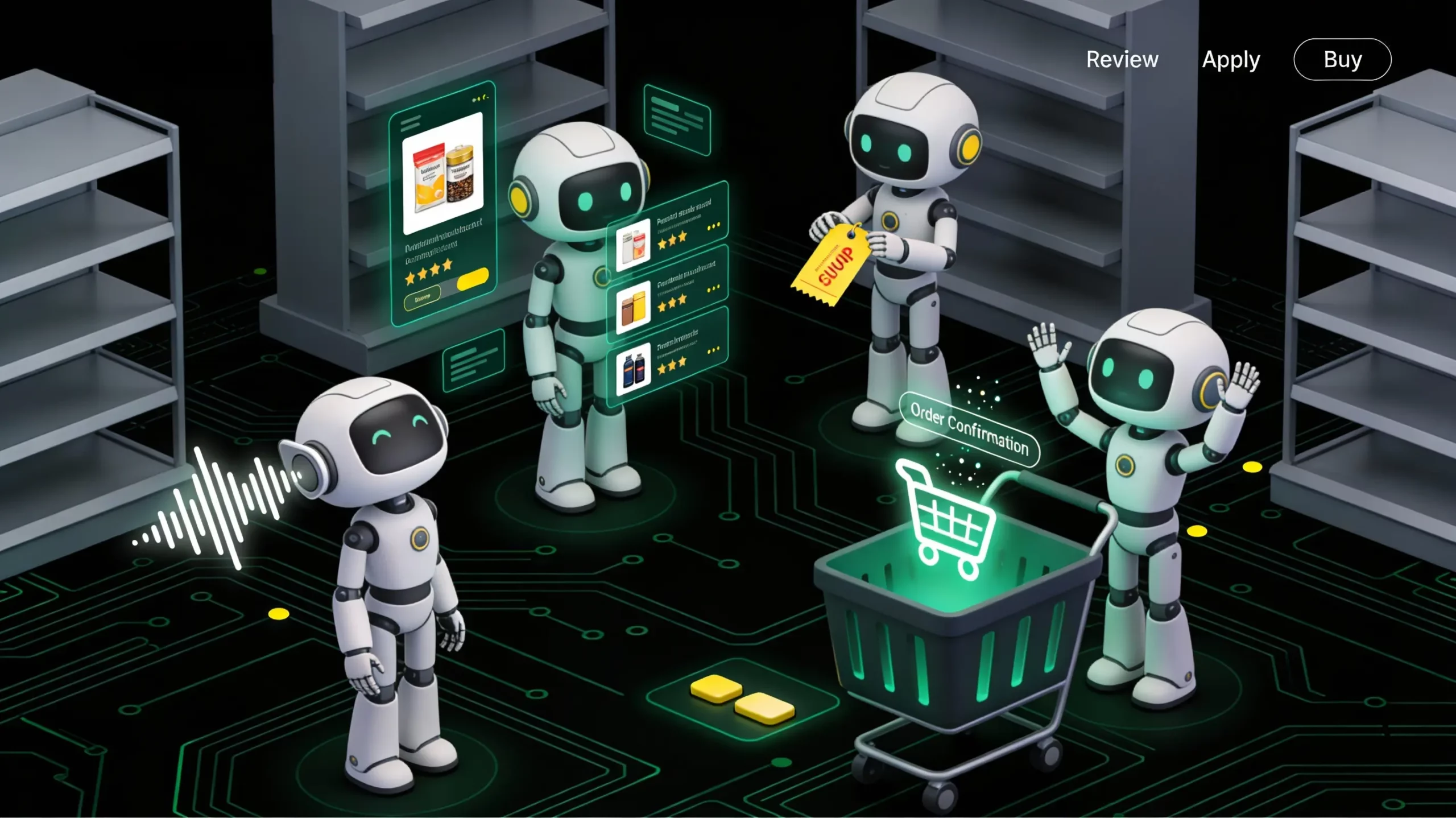
1. Understanding the Shopping Agent Shift
In the traditional e-commerce model, a user searches for “best running shoes,” opens five tabs, compares prices, and makes a choice. In the AI Agent economy, the user simply tells their personal AI: “Find me the best running shoes for flat feet under $150 that have eco-friendly materials.”
The AI agent does the browsing, filtering, and comparing in milliseconds. It doesn’t look at your banner ads or your carefully curated homepage layout. It looks at your data.
The Challenge: If your product information isn’t machine-readable, you are invisible to the agent.
The Fix: You must structure your data so that AI agents can easily parse it. This means detailed product attributes, clear pricing, and robust schema markup are no longer optional—they are your digital heartbeat.
2. Voice Commerce 2.0: From Commands to Conversations
Voice commerce is no longer just about shouting simple commands like “reorder paper towels.” By 2026, voice assistants will handle complex, multi-turn conversations. They will understand context, sentiment, and intent.
For branding, this means your brand “voice” must literally be optimized for voice search. When an AI summarizes your brand to a user, does it sound authoritative? Content needs to be conversational and direct. Long, fluffy introductions will be skipped. Instead, focus on NLP (Natural Language Processing) friendly content that answers specific questions concisely.

3. Optimizing for AEO (Answer Engine Optimization)
AEO is the art of optimizing content to be the direct answer provided by an AI. Unlike traditional rankings where being #3 is okay, in the AEO world, there is often only one answer spoken back to the user.
Q&A Format: Structure your blogs and product pages with clear “What is X?” and “How does Y work?” sections.
Fact-Based Content: AI models prioritize high-confidence, factual information. Ensure your claims are backed by data to build Trustworthiness (the “T” in EEAT).
4. The Role of “Digital Trust” and EEAT
AI agents are programmed to minimize risk. They will not recommend a product with vague reviews or questionable origins. They look for signals of Experience, Expertise, Authoritativeness, and Trustworthiness (EEAT).
Customer Reviews: Agents analyze sentiment across thousands of reviews instantly. One bad week of customer service can poison the “well” from which the AI drinks.
Expert Authorship: Ensure your content is written or reviewed by experts. An AI is more likely to cite a marketing strategy article written by an agency with proven awards than a generic blog.
5. Preparing Your Data Infrastructure
To be “agent-ready,” your backend needs to be as polished as your frontend.
Structured Data: Use detailed Schema.org markup for every product.
API Accessibility: In the near future, allowing shopping bots to access your real-time inventory via API will be a competitive advantage.
Consistency: Ensure your pricing and specs are identical across your website, social commerce channels, and third-party marketplaces.
Conclusion
The First Mover Advantage
The brands that treat AI agents as a primary customer demographic will dominate the 2025-2026 landscape. It’s not just about digital marketing anymore, it’s about digital availability.
FAQ’s
Q1: What is the AI Agent Economy?
A: It is a new market landscape where autonomous AI bots research, compare, and purchase products on behalf of human consumers.
Q2: How do I optimize my brand for AI shopping agents?
A: You must ensure your product data is structured with detailed Schema markup and is easily readable by machine algorithms.
Q3: What is the difference between SEO and AEO?
A: SEO optimizes for clicks on a search page, while AEO (Answer Engine Optimization) structures content to be the single, direct answer spoken by an AI.
Q4: Why is Voice Commerce 2.0 important for 2025?
A: Voice assistants are evolving from simple commands to complex, multi-turn conversations that require brands to have conversational, high-context content.
Q5: How does EEAT influence AI recommendations?
A: AI agents prioritize risk reduction, so they only recommend brands that demonstrate high Experience, Expertise, Authoritativeness, and Trustworthiness.
