



By 2026, the traditional production agency playbook is dead. The old formula—long timelines, massive budgets, bloated crews—cannot compete with lean, AI‑augmented teams shipping faster and cheaper. As a result, the winners are no longer the biggest agencies; they are the ones that cracked the code on producing broadcast‑quality content in weeks, not months, through hybrid human‑AI workflows.
For example, one mid‑sized production agency reported producing 40% more output with 30% fewer staff after implementing AI‑assisted editing, automated color grading, and conversational AI for client communication. Another agency cut pre‑production timelines from 8 weeks to 2 by using AI storyboarding tools, which fundamentally changed how fast they could move from idea to shoot. In practice, the production playbook in 2026 is less about having the most expensive equipment and more about having the smartest process.
For production houses, independent creators, and agencies wrestling with margin compression, the core question has shifted. It is no longer “How do we compete on budget?” but “How do we become a production engine, not just a production studio?”
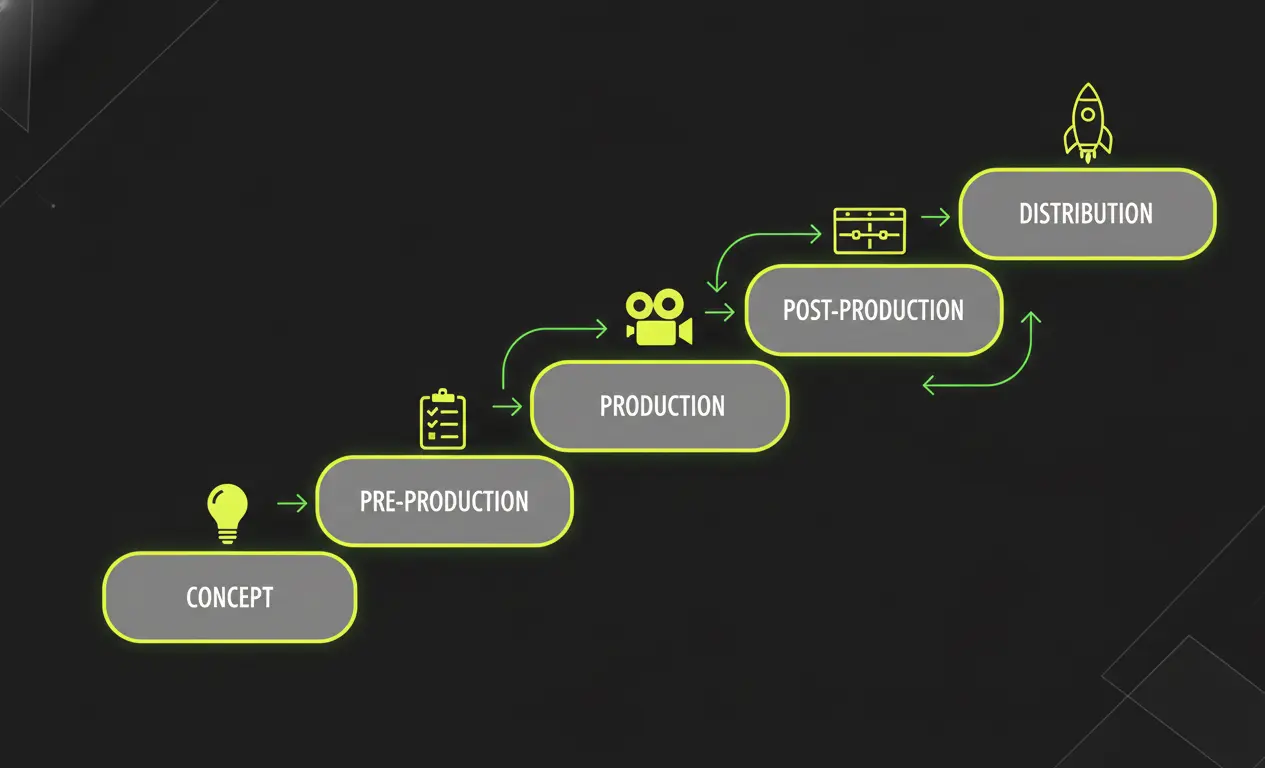
Who This Playbook Is For
This modern formula is built for teams that need to ship more content without burning out their staff or destroying quality. It serves traditional production houses adapting to brand‑led content, agencies running multi‑platform campaigns, and serious creators turning channels into revenue engines.
Moreover, it speaks directly to teams that feel squeezed between client expectations and shrinking margins. Instead of accepting slower timelines as “just how production works,” these teams are using AI to restructure how work moves from concept to launch.
Phase 1: Concept Development (Weeks 1–2)
Modern production does not start with brainstorms; instead, it starts with data. What is the customer journey, which emotional moment are you trying to capture, and where in their decision‑making does this content land?
When exploring customer journey mapping and AI‑driven insights, you quickly see why this matters. Production teams that understand where their content sits in the journey often create significantly higher engagement, because they are not making “nice” content—they are making content that converts.
AI accelerates this phase dramatically. Tools like ChatGPT generate dozens of concept variations in hours, while image models create visual references that make ideas tangible for clients. By week 2, you are reviewing a tested shortlist of concepts rather than relying on three gut‑instinct ideas, and the data clearly determines which direction moves forward.
Phase 2: Pre‑Production and Creative Direction (Weeks 3–4)
This is where clarity beats chaos. The principle that clarity beats creativity applies hard in 2026: the agencies winning are not the ones with the most artistic shots, but the ones with laser‑focused creative briefs that eliminate ambiguity.
Modern pre‑production demands crystal‑clear asset lists, shot breakdowns, and decision frameworks before anyone picks up a camera. Here, AI streamlines the process by auto‑generating shot lists from scripts, suggesting optimal camera angles, and even predicting which scenes will hit key emotional beats.
Consequently, the key shift is to spend around 40% of pre‑production time documenting constraints instead of endlessly polishing mood boards. What is the actual deliverable, which platforms will it live on, what are the technical specs, and what is the precise emotional intent? Once this foundation is locked, creativity can follow clarity instead of fighting against it.
Phase 3: Production and Hybrid Workflows (Weeks 5–8)
Phase 3 is where human and AI workflows collide in a productive way. Modern production is not “human or AI”; rather, it is “human plus AI.”
Humans still own emotional direction, actor performance, cultural nuance, and creative intuition at every step. At the same time, AI handles continuity tracking, real‑time color suggestions, lens optimization support, and even rough dialogue timing so crews can move faster with fewer retakes.
For instance, one production company reports 40% faster shoots after deploying AI systems to monitor technical consistency in real time, which frees the creative director to focus purely on performance and emotion. Another team uses AI‑driven voice isolation to record clean dialogue even in noisy locations, thereby reducing reshoots and ADR work.
When balancing AI and human creativity, the winners do not replace humans—they amplify them. AI does not direct actors or approve creativity; instead, it quietly handles repetitive technical work so humans can stay in charge of the story.
Phase 4: Post‑Production and Smart Editing (Weeks 9–12)
Traditional post‑production resembles assembly‑line work: color grade, sound design, VFX, and motion graphics all move in a linear, slow sequence. In contrast, modern agencies run parallel workflows using AI so teams can work on multiple passes at the same time.
Typically, AI now assembles first‑pass edits from footage, applies studio‑standard color grades, processes voice tracks, and generates multilingual subtitles in minutes. Editors and colorists then step in to refine the creative details instead of spending hours on basic assembly.
As a result, one agency reports up to 60% faster post‑production timelines when AI completes the mechanical tasks first. The editor gains the creative bandwidth to make nuanced cuts, explore alternate storylines, and craft pacing that truly lands with the audience.
Phase 5: Distribution and Real‑Time Optimization (Weeks 13–14)
Launch is no longer the end; instead, it becomes the beginning of your optimization loop. Modern agencies test, learn, and iterate on content across platforms in real time rather than waiting for a single campaign report.
AI‑powered dynamic tools now adapt your video for vertical, horizontal, and square formats automatically, while also generating metadata and subtitles instantly. In parallel, A/B testing systems iterate on cuts, pacing, and hooks, with AI suggesting which variations perform best for each audience segment.
Implementing conversational marketing strategies becomes critical at this stage. When AI chatbots are ready to answer real‑time questions about your content, many teams see significantly higher engagement and better conversion from interested viewers.
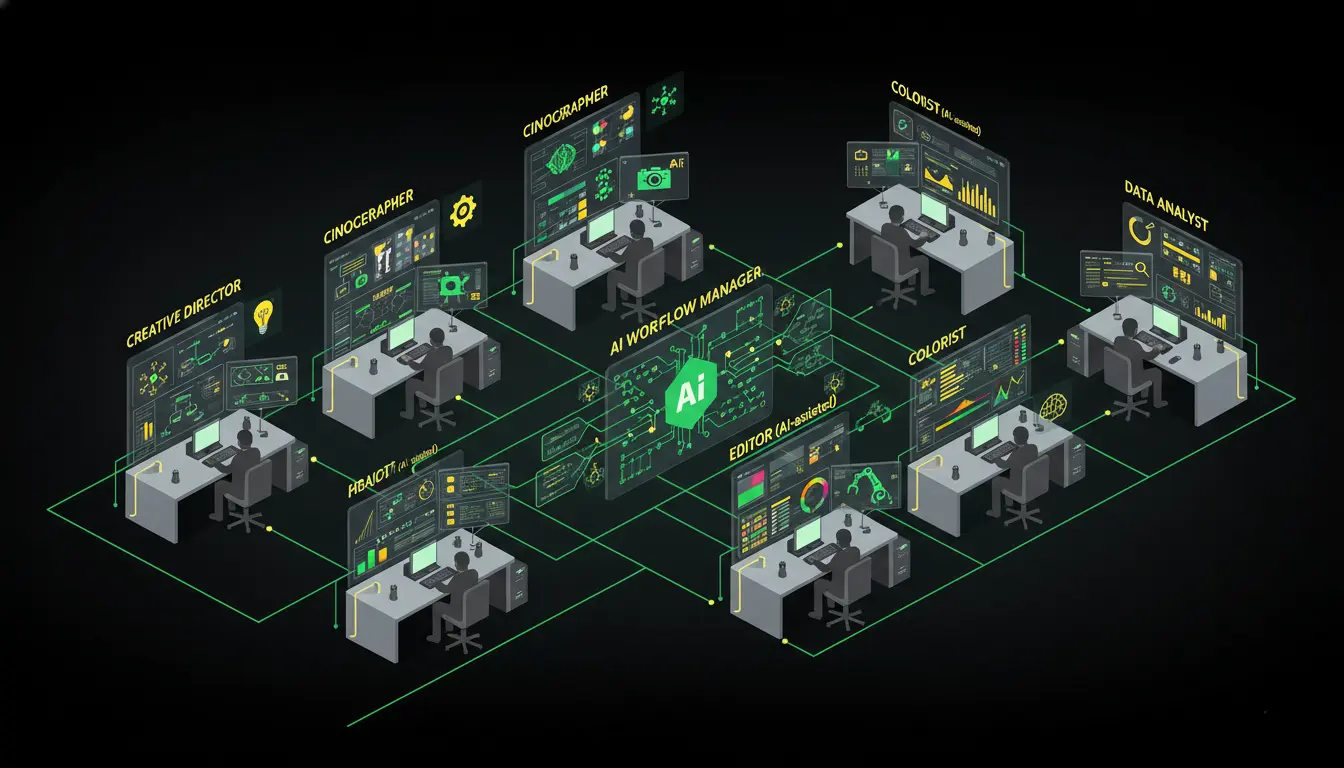
The Hybrid Team Structure
In this new environment, team structure changes as much as tools do. Creative roles remain human‑led, while execution roles become heavily AI‑augmented and entirely new AI‑native roles emerge.
Creative roles (human‑led):
-
Creative Director
-
Producer (strategy and story)
-
Cinematographer (framing and performance)
Execution roles (AI‑augmented):
-
Editor (AI handles rough cuts, humans refine)
-
Colorist (AI performs first passes, humans approve and stylize)
-
Motion Graphics Designer (AI generates variations, humans select and polish)
-
Transcription/Subtitling Specialist (AI auto‑generates, humans edit)
New roles (AI‑native):
-
AI Workflow Manager (optimizes which tasks use AI and how)
-
Data Analyst (measures content performance in real time)
-
Platform Specialist (manages multi‑platform distribution and format strategy)
A typical budget allocation reflects this structure: about 50% goes to creative talent, 25% to production tech like cameras and lights, 15% to AI tools and software, and 10% to distribution and testing.
The Reality Check: Speed vs. Story
The biggest risk in modern production is becoming a content factory that ships volume but not value. Yes, AI can help you produce far more pieces, but if each one is mediocre, you have only scaled the wrong thing.
Agencies thriving in 2026 use AI primarily to eliminate busywork, not to replace creative thinking. They deliberately use the time saved for deeper strategic planning, stronger narratives, and more thoughtful experimentation.
A powerful playbook is to reinvest roughly 30% of saved time into story depth, emotional intelligence, and testing variations. In doing so, teams often end up producing several times more content, significantly faster, while also lifting overall quality instead of eroding it.
Conclusion: The New Production Formula
The production playbook in 2026 is not revolutionary so much as evolutionary. Phases 1 and 2 become faster through AI‑driven insight, while Phases 3 to 5 become more efficient through hybrid workflows; throughout, creative direction remains distinctly human.
Ultimately, the winners are not agencies with the biggest budgets. They are the ones that have cracked the human‑AI hybrid production formula and turned it into a repeatable operating system. Garage Collective helps production agencies architect this playbook—from AI‑accelerated concept development through real‑time performance optimization—so they can transform production timelines and margins for good.
FAQ’S
Q1. How do I implement AI in production without losing creative control?
Treat AI as an executor of technical tasks—such as color grading, first‑pass editing, and subtitle generation—while humans always own story, direction, and final approval.
Q2. What time savings can I expect from AI production tools?
Teams commonly see 30–40% shorter pre‑production timelines, up to 50% faster editing, and as much as 80% faster repetitive post‑production tasks, turning an 8‑week project into roughly 4–5 weeks without quality loss.
Q3. Which roles can AI realistically replace in a production agency?
In practice, AI does not fully replace creative roles; instead, it reduces technical assembly work so editors and colorists spend much more time on high‑value creative decisions.
Q4. How do I measure whether hybrid AI workflows are working?
Track timeline compression, cost per finished minute, engagement metrics on final content, and internal team satisfaction, then review whether margins improve by at least 25–35% within a few months.
Q5. What is the learning curve for teams adopting AI production tools?
Most teams reach operational comfort within a few weeks and need a couple of months to optimize deeply, especially if they appoint one or two “AI champions” to lead training and experimentation.
