Google Ads Negative Keywords: How to Find, Add & Optimize Them in 2026
Ammar
AI Specialist
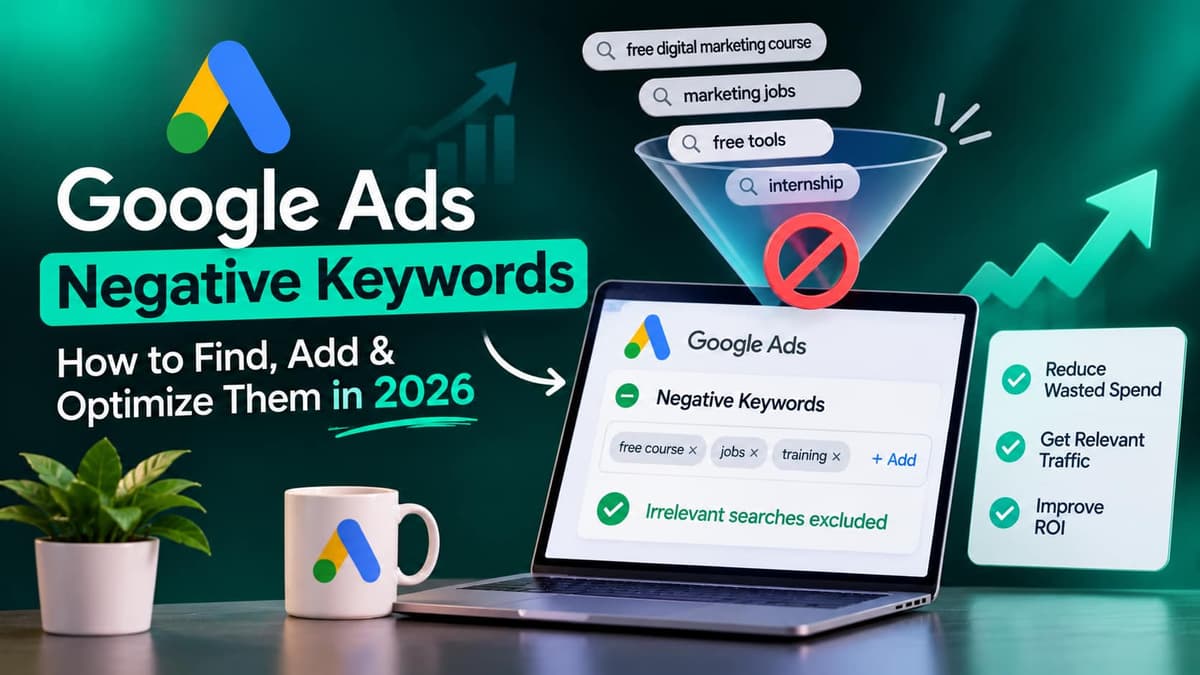
Are your Google Ads campaigns spending money on searches that have nothing to do with your business? Irrelevant search queries can attract the wrong visitors, consume your advertising budget and make campaign performance harder to evaluate. Negative keywords help advertisers prevent ads from appearing for selected irrelevant searches. In this guide, we explain negative keyword match types, how to find unwanted search terms, how to add exclusions and how Indian businesses can build a smarter Google Ads optimization process.
What Are Negative Keywords in Google Ads?
Negative keywords are words or phrases that prevent your advertisements from appearing for selected irrelevant search queries. For example, imagine you run a premium digital marketing agency. You want your ads to appear for searches such as:
• Digital marketing agency in India
• Performance marketing agency
• Google Ads management services
However, you may not want to attract people searching for:
• Free digital marketing courses
• Digital marketing jobs
• Free marketing tools
• Digital marketing internships
Adding suitable negative keywords can help filter out some of these irrelevant searches. Google Ads describes negative keywords as a way to exclude searches that are not relevant to the products or services you offer.
1. Why Are Negative Keywords Important?
Running Google Ads is not just about selecting the right keywords. It is also about identifying which searches should not trigger your advertisements. Here are five reasons to manage negative keywords carefully.
1. Reduce Irrelevant Clicks
Your ads may appear for searches that are related to your keywords but do not match your actual offering. Negative keywords help exclude selected irrelevant queries.
2. Improve Traffic Relevance
When you exclude searches with the wrong intent, you can focus more of your campaign on relevant potential customers.
3. Protect Your Advertising Budget
Clicks from irrelevant searches can consume budget without generating meaningful business opportunities.
4. Improve Campaign Control
Negative keyword lists allow advertisers to manage exclusions across selected campaigns instead of adding the same terms repeatedly.
5. Support Better Optimization
Reviewing search terms helps you understand what people are actually looking for when your advertisements appear.
2. Types of Negative Keyword Match Types
Google Ads offers three negative keyword match types for Search campaigns. According to Google's official negative keyword documentation, advertisers can use different matching options to exclude irrelevant searches. Understanding their differences is important because negative keywords behave differently from positive keywords.
| Match Type | How It Works | Example |
|---|---|---|
| Broad match | Excludes searches containing all negative keyword terms, in any order | digital marketing course |
| Phrase match | Excludes searches containing the phrase in the same order | "digital marketing course" |
| Exact match | Excludes the exact search phrase without additional words | [digital marketing course] |
Negative Broad Match
A negative broad match keyword prevents your ad from appearing when a search contains all the terms in your negative keyword, even if they appear in a different order. For example, adding: digital marketing course can exclude:
• Best digital marketing course
• Course for digital marketing
• Digital marketing online course
It may still allow a search containing only some of those terms.
Negative Phrase Match
Negative phrase match excludes searches containing the specified phrase in the same order, even when additional words are present. For example: "digital marketing course" can exclude:
• Best digital marketing course in India
• Affordable digital marketing course
Negative Exact Match
Negative exact match excludes a search when it contains exactly the specified terms, in the same order, without additional words. For example: [digital marketing course] can exclude that exact query while allowing a longer search such as: Best digital marketing course in India. Important: Negative keywords do not automatically match close variants, synonyms or singular and plural versions. You may need to add those separately. Always check Google's current matching rules before applying large exclusion lists.
3. How to Find Negative Keywords Using the Search Terms Report
One of the most useful ways to discover negative keywords is by reviewing the actual searches that triggered your ads. Follow these steps:
Step 1: Open Google Ads
Log in to your Google Ads account and select the campaign you want to review.
Step 3: Review Actual Search Queries
Look for searches that:
• Are unrelated to your products or services.
• Show job or internship intent when you are advertising a service.
• Include free-resource searches when you sell paid services.
• Attract irrelevant locations or audiences.
• Generate clicks without meaningful business relevance.
Step 4: Select Irrelevant Searches
Select the search terms you want to exclude.
Step 5: Add as Negative Keywords
Choose whether to add the exclusions to:
• An ad group
• A campaign
• An existing negative keyword list
• A new negative keyword list
Step 6: Save and Review
Save your changes and monitor the campaign to ensure relevant searches are not being blocked. Google's official instructions explain this process in the Search Terms Report documentation.
4. Negative Keyword List Examples for Different Businesses
There is no universal negative keyword list that is safe for every business. The following are starter ideas. Review each term against your offer before adding it.
| Business Type | Possible Negative Keywords |
|---|---|
| Digital marketing agency | jobs, salary, internship, free course |
| Premium e-commerce brand | free samples, wholesale, repair, used |
| Software company | cracked, torrent, pirated, free download |
| Professional services | jobs, career, training, certification |
| Local service business | unrelated city names, jobs, DIY |
Example for a Digital Marketing Agency
If you offer paid marketing services, you may want to review searches containing:
• Digital marketing jobs
• Digital marketing internship
• Free SEO course
• Marketing salary
• Digital marketing training
However, do not automatically exclude words such as "free", "price" or "cheap" across every campaign. Some searches containing these words may still come from potential customers.
5. Where Should You Add Negative Keywords?
Google Ads provides different levels for managing exclusions. Google also provides account-level negative keyword settings to help advertisers manage exclusions across eligible campaigns.
| Level | Purpose |
|---|---|
| Ad group | Exclude searches from a specific ad group |
| Campaign | Exclude searches from one campaign |
| Shared negative keyword list | Reuse exclusions across selected campaigns |
| Account level | Apply eligible exclusions across relevant campaign inventory |
Choose the level according to how broadly the exclusion should apply. For example, if a particular search term is irrelevant to every campaign, a shared or account-level exclusion may be appropriate. If it is irrelevant to only one service, keep it at the campaign or ad group level.
6. Common Negative Keyword Mistakes to Avoid
Mistake 1: Copying Generic Lists Without Reviewing Them A negative keyword that is useful for one company could block valuable customers for another. Build your list using actual campaign search data. Mistake 2: Using the Wrong Match Type An overly broad exclusion can prevent relevant searches from triggering your ads. Understand the matching rules before applying it. Mistake 3: Ignoring Singular and Plural Variations Negative keywords do not automatically cover all close variants. Review relevant variations separately. Mistake 4: Adding Too Many Exclusions More negative keywords do not automatically mean better performance. Excessive exclusions can reduce your reach and prevent valuable traffic. Mistake 5: Never Reviewing Search Terms Again Customer searches, campaign objectives and business offerings change. Negative keyword management should be an ongoing activity.
7. How Often Should You Review Negative Keywords?
Your review frequency should depend on campaign activity and search volume. Here is a practical starting schedule:
| Frequency | Activity |
|---|---|
| Daily | Check major spending anomalies |
| Weekly | Review search terms and add relevant exclusions |
| Monthly | Audit negative keyword lists and campaign overlap |
| Quarterly | Reassess targeting strategy and business relevance |
These are suggested operating intervals, not mandatory Google requirements.
8. Google Ads Negative Keyword Optimization Checklist
Before making changes to your campaigns, review this checklist:
• Check the Search Terms Report.
• Identify irrelevant search intent.
• Review search volume and spending.
• Select the appropriate negative match type.
• Check existing campaign exclusions.
• Avoid blocking relevant commercial searches.
• Organize reusable negative keyword lists.
• Monitor impressions and relevant conversions after changes.
• Review the list regularly.
9. How Negative Keywords Fit Into a Larger Google Ads Strategy
Negative keywords are only one part of effective Google Ads management. A strong campaign also needs: Keyword Research: Identify relevant searches and understand customer intent. Campaign Structure: Organize campaigns and ad groups around clear business objectives. Ad Copy: Ensure advertisements communicate the right offer. Landing Page Optimization: Match the landing page with the advertisement and user expectations. Conversion Tracking: Measure genuine enquiries, purchases and other important actions. Performance Monitoring: Evaluate qualified leads, acquisition costs and revenue rather than relying only on clicks. Businesses that combine these activities can make more informed advertising decisions.
10. How Garage Collective Approaches Performance Marketing
At Garage Collective, performance marketing involves more than launching advertisements. Campaign strategy, audience relevance, creative development, analytics, conversion tracking and continuous optimization all contribute to the process. A structured approach helps businesses understand where their advertising budget is going and which activities are contributing to meaningful outcomes. Explore our performance marketing solutions to learn how Google Ads, Meta Ads, analytics and conversion optimization can work together.
Frequently Asked Questions
What are negative keywords in Google Ads?
Negative keywords are words or phrases used to prevent advertisements from appearing for selected irrelevant searches.
How do I add negative keywords in Google Ads?
Open your Google Ads account, navigate to Search Terms, select irrelevant queries and choose Add as negative keyword. You can apply them at the ad group, campaign or list level.
What are the three negative keyword match types?
Google Ads supports negative broad match, negative phrase match and negative exact match for Search campaigns.
Do negative keywords improve Google Ads performance?
They can help reduce irrelevant search traffic and improve targeting. However, results depend on campaign structure, search intent and the quality of your exclusions.
How many negative keywords should I add?
There is no ideal number for every account. Add exclusions based on actual search data and business relevance rather than trying to reach a particular keyword count.
Do negative keywords match synonyms and close variants?
No. Negative keywords do not automatically match close variants or synonyms. Review and add relevant variations separately.
How often should I update negative keywords?
Weekly search-term reviews are a practical starting point for active campaigns. Higher-spend accounts may require more frequent monitoring.
Can negative keywords block potential customers?
Yes. Incorrect exclusions or overly broad negative match types can block relevant searches. Review every exclusion carefully before applying it.
Conclusion
Negative keywords play an important role in managing Google Ads campaigns effectively. By reviewing search terms, identifying irrelevant intent and selecting appropriate exclusion match types, businesses can gain better control over where their advertisements appear. However, the objective should not be to block as many searches as possible. It should be to attract the right audience and improve the quality of campaign traffic. Want to improve your advertising performance? Explore Garage Collective's performance marketing services and build a more focused, measurable advertising strategy.
Like what you're reading?
Get a free marketing plan tailored to your brand
Get Your Free Planyes, actually free. we're not kidding.
Key Takeaways
- Negative keywords help prevent ads from appearing for irrelevant searches.
- Google Ads supports broad, phrase and exact negative match types.
- Use the Search Terms Report to identify unwanted traffic.
- Avoid excessive exclusions that could block potential customers.
- Review negative keyword lists regularly to maintain campaign relevance.
the TL;DR your boss will love
This Isn't Just Theory. We Do This Daily.
Let us show you exactly what we'd do for your brand - strategy, channels, budget, timeline. Free. No pitch deck.
Get Smarter Every Week
Ideas, data, and the occasional hot take. Biweekly, no spam.
we promise not to sell your email to robots
You Might Also Dig These
^ we picked these just for you (okay, the algorithm did)
Google's October 2026 AI Content Guidance: SEO and E-E-A-T Checklist
Google updated its guidance on generative AI content on 1 October 2026, aligning the documentation more closely with its Search Quality Rater Guidelines. The update does not create a special ranking system for AI-written pages. It sharpens the standard that matters: content should serve a clear audience, demonstrate real expertise and make factual claims easy to verify. For Indian marketing teams using AI at scale, the operational question is no longer whether AI may be used. It is whether every published page adds original value, accountable authorship and dependable evidence.
ReadIndia Festive Commerce Playbook 2026: D2C, Quick Commerce and Always-On Growth
India’s festive season remains a major commercial opportunity, but e-commerce demand is no longer limited to a few sale events. NIQ describes a market shaped by both habitual purchases and event-driven peaks, while Meta points to video-first discovery, creators and messaging-led commerce. A useful festive plan connects demand forecasting, channel roles, creative and customer experience from discovery through repeat purchase.
ReadUltimate Guide to AI-First Agency Month: Optimize Performance Marketing ROI Amid Rising Ad Costs in India
Struggling to keep up with rising ad costs and ever-changing Google and Meta algorithms? Indian marketers, startups, and D2C brands are feeling the pressure to scale smarter - not harder. Ready to cut through the noise and supercharge your performance marketing ROI? This guide reveals AI-first strategies, proprietary tools, and proven tactics to help you stay ahead and win big in India’s digital market.
Read