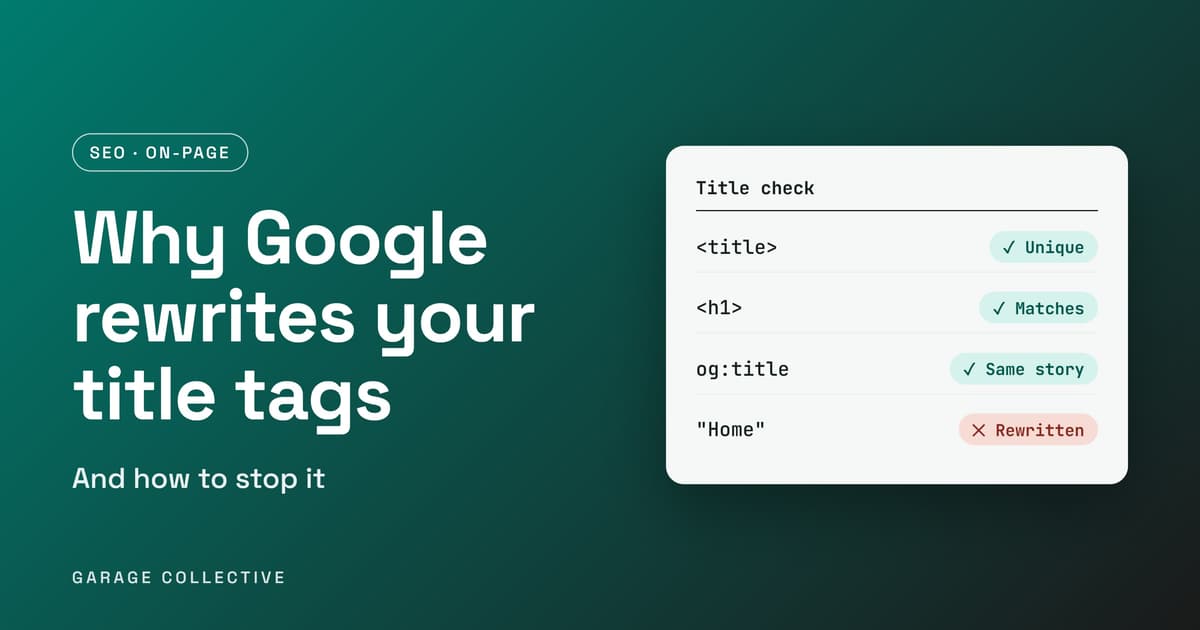
Why Google Rewrites Your Title Tags (and How to Stop It)
Ammar
AI Specialist

You spent ten minutes polishing a title tag. Google looked at it, shrugged, and showed something else. It feels personal, but it usually is not: Google's documentation lists specific situations where it swaps in its own title link, and most of them are problems on your side that you can fix. This guide walks through the nine places Google looks for a title, the seven triggers that make it rewrite one, and a short checklist for writing titles that stay put.
Your title tag is a suggestion, not a command
Google calls the clickable headline in search results a title link, and it builds that headline automatically. Your
The nine places Google looks
According to Google's documentation, a title link can be built from any of these:
• The content of your
• The main visual title shown on the page
• Heading elements such as
• og:title meta tags
• Other large or prominent text, based on styling
• Other text on the page
• Anchor text on the page
• Text in links that point to the page
• WebSite structured data
The takeaway is that your
, your anchors and your visual design all vote on the title. If they disagree with your , expect a rewrite.
The seven triggers that make Google rewrite a title
Google lists specific issues that can lead it to generate a different title link. Here they are with a fix for each.
| Trigger | What it looks like | Fix |
|---|---|---|
| Half-empty title | The title is just a site name, or part of it is missing | Write a full descriptive title for every page |
| Obsolete title | The <title> still shows an old date while the visible heading shows the current one | Update the title whenever the heading changes |
| Inaccurate title | The title does not match the page, often because of dynamic text | Make the title describe what is really on the page |
| Micro-boilerplate | Many pages share nearly identical titles | Give each page a title that reflects its own content |
| No clear main title | Several headings look equally prominent | Make the real title stand out, for example with a larger font or as the first <h1> |
| Language or script mismatch | The title is in a different language or alphabet than the page | Match the title to the page's main language |
| Duplicated site name | The title repeats a site name Google already shows in the result | Keep the brand short and do not repeat it |
What about length?
Google does not set a character limit. Long titles are truncated for display, typically to fit the device width, and truncation is not listed as a reason for a rewrite. Our rule of thumb, not Google's: put the words that matter most at the start, so a cut-off ending costs you nothing.
How to write titles that stay put
Google's best practices boil down to a few habits:
• Give every page a unique, descriptive title. Avoid labels like "Home" or "Profile".
• Keep it concise and drop unnecessary wording.
• Do not repeat keywords. Stuffing looks spammy to Google and to people.
• Use the full site name on your home page. On other pages, put the brand at the start or end, separated by a hyphen, colon or pipe.
• Make the main title the obvious one on the page, ideally the first visible
.
• Keep
and og:title telling the same story.
A quick before and after on a made-up product page:
| Version | Title | What is wrong or right |
|---|---|---|
| Before | Buy Shoes | Vague, and likely the same on many pages |
| Before | Shoes - Shoes - Best Shoes Online | Keyword repeated three times |
| After | Black Running Shoes for Men - Brand Name | Specific, with the brand at the end |
If Google already changed your title
Google's advice is to work down a short list. First check whether the page has one of the seven issues above, and fix it if so. If it does not, ask whether the title Google shows fits the search query better than yours does. Google says it cannot manually change individual title links, and that changes to the sources can take days to weeks to show up. You can request a recrawl to speed things along.
A 20-minute title audit
• Search Google for site:yourdomain.com and scan the titles that appear. Note any that look different from what you wrote.
• For each, open the page source and compare
and og:title.
• Look for pages that share the same title and rewrite them to be distinct.
• Check pages with dates or years in the title against the visible heading.
• Make sure the main heading is the first, most prominent heading on the page.
• Update the pages, request a recrawl, and check again in a couple of weeks.
For more on getting pages quoted and understood, see our guides on structuring pages so AI Overviews quote you first and measuring with Search Console's generative AI report.
FAQ
Is there an ideal title length?
Google gives no fixed character limit. Titles are truncated to fit the device width, so put the important words first.
Why does Google show a different title than mine?
Usually because one of seven things is going on: a half-empty title, an obsolete one, an inaccurate one, near-duplicate titles across pages, no clear main heading, a language mismatch, or a repeated site name. Your h1, anchors and og:title also feed the choice.
Can I force Google to use my title?
No. Google says it cannot manually change individual title links. You can fix the issues that trigger rewrites and request a recrawl, and changes can take days to weeks to appear.
Should I put my brand name in every title?
Google's advice is to use the full site name on the home page. On other pages, put the brand at the start or end with a delimiter such as a hyphen, colon or pipe, and keep it concise.
Does the h1 matter for titles?
Yes. Headings are one of the sources Google can use, and it recommends making the main title stand out, for example as the first visible h1.
Like what you're reading?
Get a free marketing plan tailored to your brand
Get Your Free Planyes, actually free. we're not kidding.
Key Takeaways
- Your
is the strongest input for the title link, not the only one. Google can also use headings, og:title, anchors and structured data. - Google lists seven triggers for rewriting titles, and most are fixable on your side.
- There is no character limit. Titles are truncated by device width, so put the key words first.
- Give every page a unique, descriptive title and keep the brand short, at the start or end.
- Keep title, h1 and og:title consistent, and expect days to weeks for a fix to show.
the TL;DR your boss will love
This Isn't Just Theory. We Do This Daily.
Let us show you exactly what we'd do for your brand - strategy, channels, budget, timeline. Free. No pitch deck.
Get Smarter Every Week
Ideas, data, and the occasional hot take. Biweekly, no spam.
we promise not to sell your email to robots
You Might Also Dig These
^ we picked these just for you (okay, the algorithm did)
Google's October 2026 AI Content Guidance: SEO and E-E-A-T Checklist
Google updated its guidance on generative AI content on 1 October 2026, aligning the documentation more closely with its Search Quality Rater Guidelines. The update does not create a special ranking system for AI-written pages. It sharpens the standard that matters: content should serve a clear audience, demonstrate real expertise and make factual claims easy to verify. For Indian marketing teams using AI at scale, the operational question is no longer whether AI may be used. It is whether every published page adds original value, accountable authorship and dependable evidence.
ReadIndia Festive Commerce Playbook 2026: D2C, Quick Commerce and Always-On Growth
India’s festive season remains a major commercial opportunity, but e-commerce demand is no longer limited to a few sale events. NIQ describes a market shaped by both habitual purchases and event-driven peaks, while Meta points to video-first discovery, creators and messaging-led commerce. A useful festive plan connects demand forecasting, channel roles, creative and customer experience from discovery through repeat purchase.
ReadUltimate Guide to AI-First Agency Month: Optimize Performance Marketing ROI Amid Rising Ad Costs in India
Struggling to keep up with rising ad costs and ever-changing Google and Meta algorithms? Indian marketers, startups, and D2C brands are feeling the pressure to scale smarter - not harder. Ready to cut through the noise and supercharge your performance marketing ROI? This guide reveals AI-first strategies, proprietary tools, and proven tactics to help you stay ahead and win big in India’s digital market.
Read