Quick Commerce: New Rules of Creative Advertising
Dr. Ankoor
Chief Experience Officer
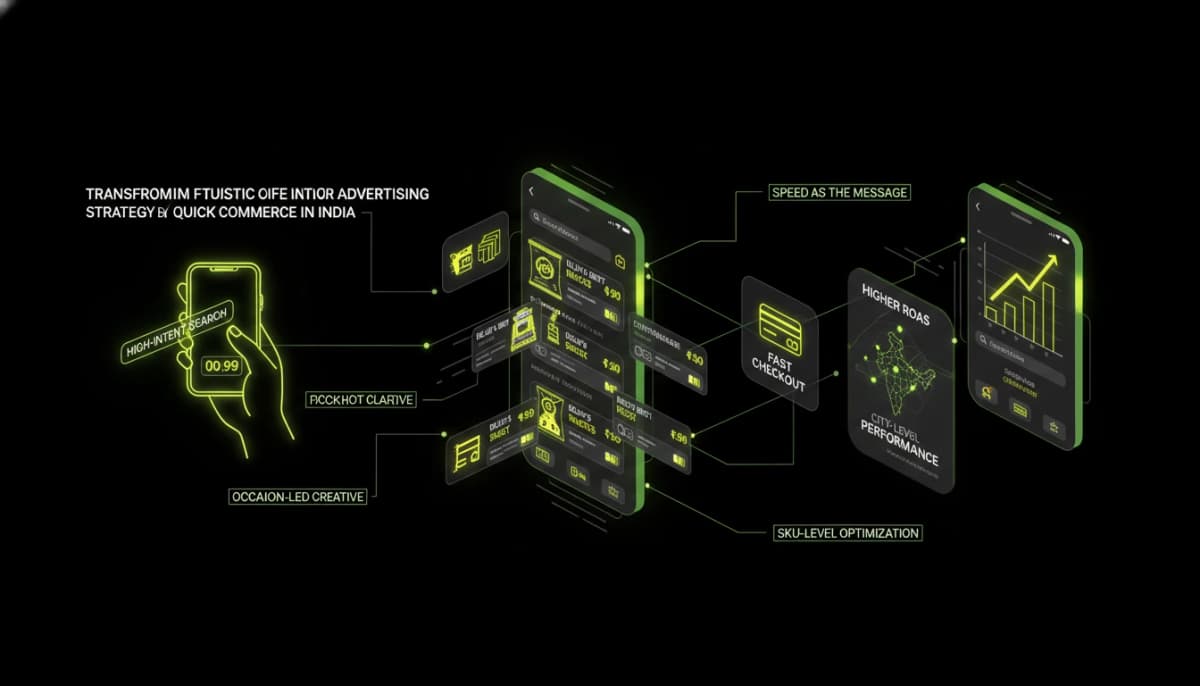
Most brand managers are still writing briefs for the old internet. Quick commerce has changed the rules, shifting advertising from long consideration cycles to instant purchase intent. That means creative now has to win in seconds, not weeks.
How Quick Commerce Is Rewriting the Rules of Creative Advertising in India
Most brand managers are still writing briefs for the old internet. Awareness campaigns, long consideration cycles, and top-of-funnel storytelling were built to nudge consumers over time. Quick commerce has made that playbook nearly obsolete. When someone opens Blinkit or Zepto, they are not browsing. They are buying. That shift from passive discovery to active purchase intent changes everything about how creative advertising must be built in India.
The Scale Makes This Non-Negotiable
This is not a niche trend worth monitoring from a distance. Quick commerce ad revenue in India is projected to hit Rs 4,900 crore in 2026, up from Rs 3,000 crore the previous year. Brands across FMCG, personal care, and food are not experimenting with Q-commerce advertising - they are reallocating core budgets to it. The market crossed $7.1 billion in early 2025, growing 150% year-on-year. And 31% of urban Indians now use Q-commerce as their primary grocery channel. The shelf has moved from retail aisles to app screens, and the creative that works on one looks nothing like what works on the other.
Why Traditional Creative Falls Flat Here
Traditional advertising is built on desire creation - you tell a story, build aspiration, and let the consumer warm up over time. Q-commerce does not give you that time. Purchase decisions on Blinkit and Zepto are made within seconds. Algorithms decide what surfaces and what disappears. A consumer’s cart is one tap away from checkout. That means your creative is not competing with other ads - it is competing with the impulse to scroll past and pick the familiar brand.
"“You are not building desire here, you are meeting it halfway.”"
This is a fundamental departure from how branding and marketing has traditionally been understood. The gap between the two is now measured in seconds.
The New Creative Rules for Q-Commerce
• Lead with the pack shot, not the emotion. In a 10-minute delivery context, the product must be unmistakable in under one second.
• Occasion-led over brand-led. Creative aligned to moments like late-night cravings or breakfast prep gains better relevance and conversion.
• Hyperlocal copy as a conversion lever. City-specific and zone-specific creative can improve click-to-cart rates.
• Speed as the message. “Here in 10 minutes” acts as both a logistics claim and a creative hook.
This is where performance marketing evolves in the Q-commerce era - from campaign-level ROAS to SKU-level, city-level, and hour-level optimisation.
Best Performing Ad Formats
• Sponsored Listings: Best for high-intent in-app search, with pack shot clarity and price anchors.
• Homepage Banners: Best for new launches and festive campaigns, with bold visuals and a single CTA.
• Occasion Placements: Best for impulse and combo buying, with context-led copy.
• In-App Search Ads: Best for category-level discovery, with keyword-matched benefit-first headlines.
Brands are already seeing 1.5 to 2 times higher ROAS on Q-commerce platforms compared to Meta and Google, with conversion rates reaching 3 to 8 percent.
What This Means for Creative Teams
The shift to Q-commerce is not just a media buying decision. It demands a rethink of how creative briefs are written, how assets are produced, and how AI and dynamic creative tools are deployed to generate hyperlocal, occasion-specific variants at scale. Creative teams that keep producing one national campaign and adapting it for digital will underperform against leaner brands producing dozens of platform-native, intent-matched assets. Speed of creative iteration is now the competitive advantage.
Like what you're reading?
Get a free marketing plan tailored to your brand
Get Your Free Planyes, actually free. we're not kidding.
Key Takeaways
- Q-commerce creative must win attention in under one second.
- Pack shots, price anchors, and delivery speed outperform emotional storytelling.
- Occasion-based and hyperlocal creative improves conversion.
- Sponsored listings and search ads work best for intent-led purchases.
- Fast testing and creative iteration matter more than large campaign budgets.
the TL;DR your boss will love
This Isn't Just Theory. We Do This Daily.
Let us show you exactly what we'd do for your brand - strategy, channels, budget, timeline. Free. No pitch deck.
Get Smarter Every Week
Ideas, data, and the occasional hot take. Biweekly, no spam.
we promise not to sell your email to robots
You Might Also Dig These
^ we picked these just for you (okay, the algorithm did)
Google's October 2026 AI Content Guidance: SEO and E-E-A-T Checklist
Google updated its guidance on generative AI content on 1 October 2026, aligning the documentation more closely with its Search Quality Rater Guidelines. The update does not create a special ranking system for AI-written pages. It sharpens the standard that matters: content should serve a clear audience, demonstrate real expertise and make factual claims easy to verify. For Indian marketing teams using AI at scale, the operational question is no longer whether AI may be used. It is whether every published page adds original value, accountable authorship and dependable evidence.
ReadIndia Festive Commerce Playbook 2026: D2C, Quick Commerce and Always-On Growth
India’s festive season remains a major commercial opportunity, but e-commerce demand is no longer limited to a few sale events. NIQ describes a market shaped by both habitual purchases and event-driven peaks, while Meta points to video-first discovery, creators and messaging-led commerce. A useful festive plan connects demand forecasting, channel roles, creative and customer experience from discovery through repeat purchase.
ReadUltimate Guide to AI-First Agency Month: Optimize Performance Marketing ROI Amid Rising Ad Costs in India
Struggling to keep up with rising ad costs and ever-changing Google and Meta algorithms? Indian marketers, startups, and D2C brands are feeling the pressure to scale smarter - not harder. Ready to cut through the noise and supercharge your performance marketing ROI? This guide reveals AI-first strategies, proprietary tools, and proven tactics to help you stay ahead and win big in India’s digital market.
Read