301 vs 302 Redirects: What Google Does With Each
Ammar
AI Specialist
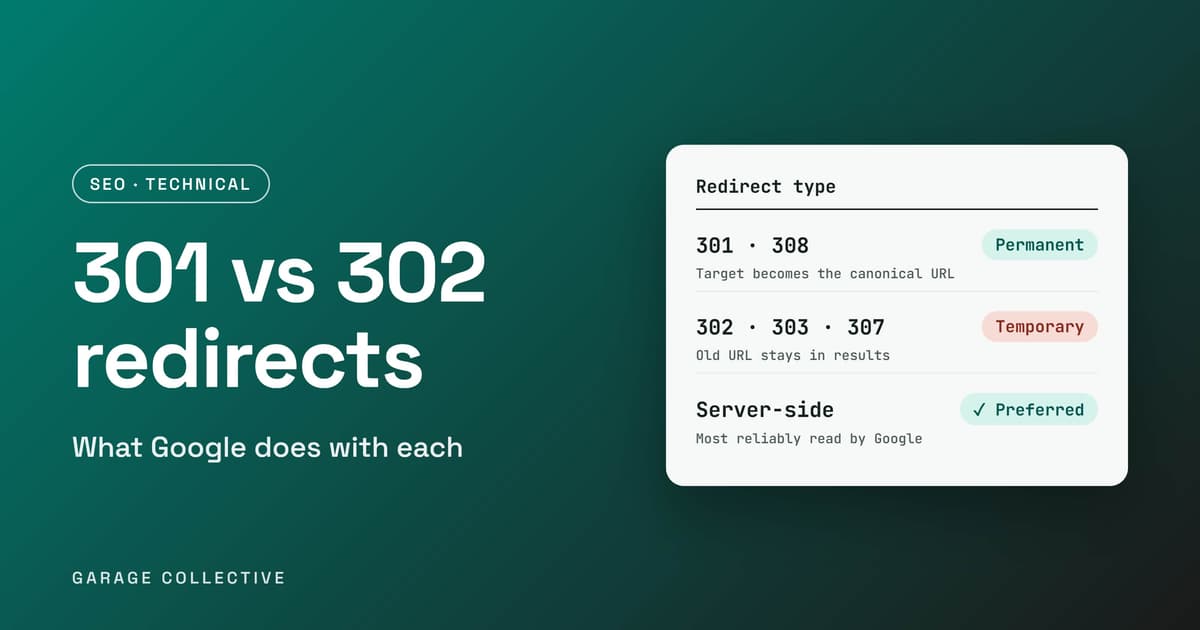
A redirect looks like a small technical detail until it goes wrong. Move a page with a temporary redirect and Google keeps showing the old URL. Move it with a JavaScript redirect and Google might never see the move at all. Google's redirect documentation spells out exactly how it reads each type, and the rules are simple once you see them side by side. This guide covers permanent versus temporary redirects, which status codes fall into which group, which method to prefer, and a short audit you can run on your own site.
When you need a redirect
Google says redirects tell users and search engines that a page has a new location. The usual reasons are moving to a new domain, consolidating duplicate URLs such as http versus https or www versus non-www onto one preferred URL, merging sites, and replacing a page you have removed. Some platforms, including Blogger and Shopify, have built-in redirect tools.
Permanent or temporary: the one decision that matters
Every redirect is either permanent or temporary, and Google reads the two differently.
| Type | What Google does | Use it when |
|---|---|---|
| Permanent | Uses the redirect target as the canonical URL and shows it in results | The move will not be reverted |
| Temporary | Keeps the source URL as the one shown in results. The target may still be indexed if other canonicalization signals point to it | The change is short-lived, for example a service that is temporarily unavailable |
The practical lesson: if you move a page for good and use a temporary redirect, you are telling Google to keep showing the old address.
Which status code is which
| Group | Codes and methods |
|---|---|
| Permanent | HTTP 301 and 308. Also a meta refresh or HTTP refresh with a 0-second delay, JavaScript location redirects, and crypto redirects |
| Temporary | HTTP 302, 303 and 307. Also a meta refresh or HTTP refresh with a delay greater than 0 seconds |
Pick the method Google reads most reliably
Google lists four methods, in this order of preference:
• Server-side redirects. Set in server configuration (such as .htaccess on Apache or the NGINX config) or in server code like PHP. Google lists these as the most reliably interpreted.
• Meta refresh. An option when you cannot do server-side redirects. An instant one counts as permanent and a delayed one as temporary.
• JavaScript redirects. Only when neither of the above is possible. Google renders JavaScript after crawling and rendering can fail, so it might never see the redirect.
• Crypto redirect. A visible link to the new page with an explanation. Google may or may not treat it as a redirect, so it is a last resort.
Two illustrative server-side examples for a permanent move:
# Apache (.htaccess) Redirect 301 /old-page https://www.example.com/new-page # NGINX location = /old-page { return 301 https://www.example.com/new-page; }
What to expect after a move
Google tracks both the old and the new URL. One becomes the canonical and the other becomes an alternate name, which may still appear in results for some queries. After a domain move, old URLs can keep showing for a while, and Google says this typically fades without action. Do not panic if the old address lingers for a few weeks.
Redirect mistakes we would check first
These are our editorial rules of thumb, not statements from Google's page:
• Using a 302 for a move that is never coming back.
• Relying on a JavaScript redirect for an important page when a server-side redirect is possible.
• Sending every removed page to the homepage. Redirect each page to the closest relevant replacement.
• Building long chains where A goes to B goes to C. Google's page does not give a hop limit, so keep chains short and point old URLs straight at the final one.
A 15-minute redirect audit
• List the redirects you set up in the last year, or pull them from your server config or CMS.
• For each, confirm the status code. A permanent move should be a 301 or 308.
• Test five old URLs in a browser and confirm they land on the right page in one hop.
• Search your site for meta refresh tags and JavaScript location redirects and replace the important ones with server-side redirects.
• Check that http to https and www to non-www (or the reverse) redirect to one preferred version.
• If you recently moved domains, check Search Console for the new URLs and give the old ones time to fade.
Planning a bigger move? Our guides on enterprise website redesigns in Delhi NCR and Shopify development and migration cover the project side.
FAQ
Is a 301 or a 302 better for SEO?
Neither is better in general. Use a permanent redirect such as a 301 or 308 when the move is for good, because Google then uses the target as the canonical URL. Use a temporary one such as a 302, 303 or 307 when the change is short-lived, because Google keeps the source URL in results.
Which redirect method does Google prefer?
Server-side redirects. Google lists them as the most reliably interpreted. Meta refresh is the fallback, JavaScript is for when nothing else is possible, and a crypto redirect is a last resort.
Does a JavaScript redirect work?
Sometimes. Google renders JavaScript after crawling and rendering can fail, so it might never see the redirect. Use it only when server-side and meta refresh redirects are not possible.
Why does my old URL still show in Google after a move?
Google tracks both URLs and may show the old one as an alternate name for some queries. After a domain move this typically fades without action.
How many redirects in a row will Google follow?
Google's redirect page does not give a hop limit. Our advice is to point each old URL straight at its final destination.
Key Takeaways (paste into the Takeaways field, one bullet per item)
• Permanent redirects (301, 308) make the target the canonical URL. Temporary ones (302, 303, 307) keep the old URL in results.
• Use a server-side redirect first. Meta refresh and JavaScript are fallbacks.
• A JavaScript redirect may never be seen if rendering fails.
• Old URLs can linger in results after a move and usually fade on their own.
• Redirect each removed page to its closest relevant replacement, and keep chains short.
Like what you're reading?
Get a free marketing plan tailored to your brand
Get Your Free Planyes, actually free. we're not kidding.
Key Takeaways
the TL;DR your boss will love
This Isn't Just Theory. We Do This Daily.
Let us show you exactly what we'd do for your brand - strategy, channels, budget, timeline. Free. No pitch deck.
Get Smarter Every Week
Ideas, data, and the occasional hot take. Biweekly, no spam.
we promise not to sell your email to robots
You Might Also Dig These
^ we picked these just for you (okay, the algorithm did)
Google's October 2026 AI Content Guidance: SEO and E-E-A-T Checklist
Google updated its guidance on generative AI content on 1 October 2026, aligning the documentation more closely with its Search Quality Rater Guidelines. The update does not create a special ranking system for AI-written pages. It sharpens the standard that matters: content should serve a clear audience, demonstrate real expertise and make factual claims easy to verify. For Indian marketing teams using AI at scale, the operational question is no longer whether AI may be used. It is whether every published page adds original value, accountable authorship and dependable evidence.
ReadIndia Festive Commerce Playbook 2026: D2C, Quick Commerce and Always-On Growth
India’s festive season remains a major commercial opportunity, but e-commerce demand is no longer limited to a few sale events. NIQ describes a market shaped by both habitual purchases and event-driven peaks, while Meta points to video-first discovery, creators and messaging-led commerce. A useful festive plan connects demand forecasting, channel roles, creative and customer experience from discovery through repeat purchase.
ReadUltimate Guide to AI-First Agency Month: Optimize Performance Marketing ROI Amid Rising Ad Costs in India
Struggling to keep up with rising ad costs and ever-changing Google and Meta algorithms? Indian marketers, startups, and D2C brands are feeling the pressure to scale smarter - not harder. Ready to cut through the noise and supercharge your performance marketing ROI? This guide reveals AI-first strategies, proprietary tools, and proven tactics to help you stay ahead and win big in India’s digital market.
Read