robots.txt for AI Crawlers: What to Allow and Block in 2026
Ammar
AI Specialist
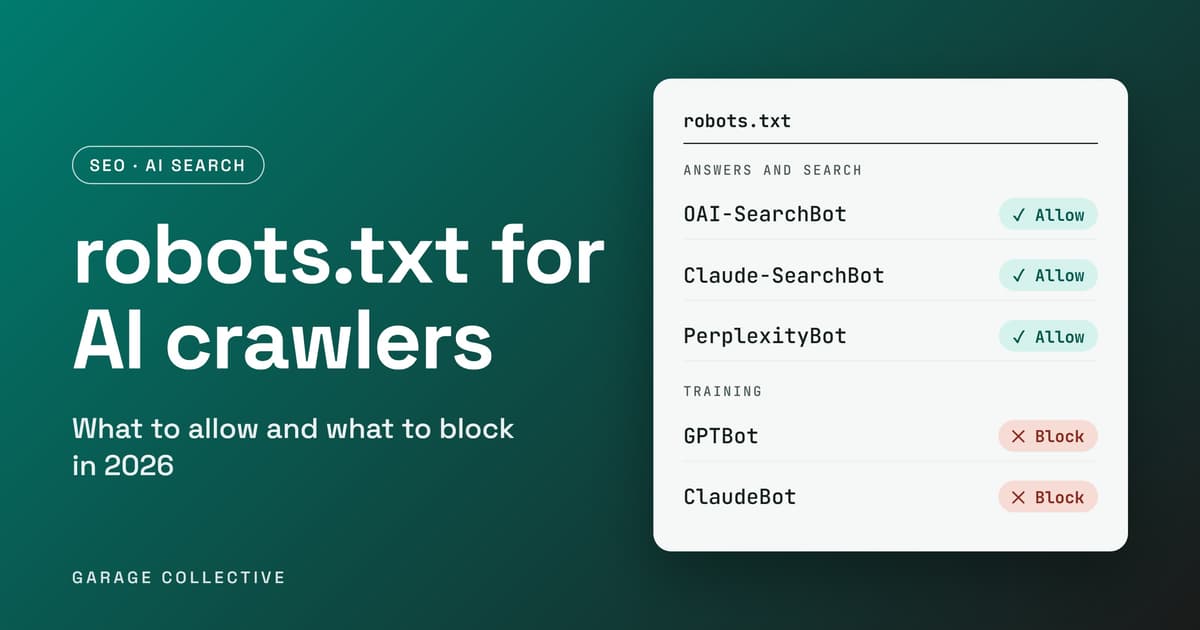
Ask ten people whether to block AI crawlers and you will get ten confident answers, most of them treating "AI crawler" as one thing. It is not. OpenAI, Anthropic, Google and Perplexity each run separate bots for separate jobs: training, building a search index, and fetching a page when a user asks a question. Block the wrong one and your brand can drop out of AI answers while training carries on regardless. This guide goes bot by bot, gives you a robots.txt to start from, and covers the firewall setting that quietly overrides all of it.
Why can't you treat AI crawlers as one thing?
Because the same company often runs three bots with three different jobs, and robots.txt lets you decide each one separately. Sorting bots by job makes every later decision easier.
• Training crawlers collect content that may be used to train future models. GPTBot and ClaudeBot sit here.
• Search crawlers build the index an AI search feature draws on. OAI-SearchBot, Claude-SearchBot and PerplexityBot sit here.
• User-triggered fetchers load a page because a person asked a question that needed it. ChatGPT-User, Claude-User and Perplexity-User sit here.
Training is a policy question about how your content gets reused. Search and user fetches are a visibility question: they decide whether an assistant can find and read you when someone asks about your category. Mix the two up and you end up opting out of the wrong thing.
Which AI crawlers should you know in 2026?
These are the bots most sites will meet in their logs. The details come from each company's published documentation, checked in October 2026. They change, so recheck before you ship.
| Bot | Run by | What it does | If you block it | Honours robots.txt? |
|---|---|---|---|---|
| OAI-SearchBot | OpenAI | Builds the index behind ChatGPT search | You will not appear in ChatGPT search answers, though you can still show up as a plain link | Yes |
| GPTBot | OpenAI | Collects content that may be used for training | Your content is not used to train OpenAI's models. Search visibility is a separate setting | Yes |
| ChatGPT-User | OpenAI | Fetches a page when a ChatGPT user or Custom GPT needs it | OpenAI says robots.txt rules may not apply, because a person triggered the request | Not guaranteed |
| Claude-SearchBot | Anthropic | Indexes content to improve Claude's search results | Can reduce your visibility and accuracy in Claude's search results | Yes |
| Claude-User | Anthropic | Fetches a page when a Claude user asks something that needs it | Can reduce your visibility for user-directed web search | Yes |
| ClaudeBot | Anthropic | Collects content that may be used for training | Signals that your content should be left out of future training data | Yes |
| PerplexityBot | Perplexity | Surfaces and links sites in Perplexity results | Perplexity recommends allowing it if you want to appear | Yes |
| Perplexity-User | Perplexity | Fetches a page when a Perplexity user asks something that needs it | Perplexity says it generally ignores robots.txt | Generally not |
| Googlebot | Crawls for Search, which includes AI Overviews and AI Mode | You drop out of Search and its AI features | Yes | |
| Google-Extended | A robots.txt token for AI training and grounding in some other Google systems | Opts you out of that use. Google says it does not affect Search inclusion or ranking | Yes |
Opts you out of that use. Google says it does not affect Search inclusion or ranking Yes Two small notes. Anthropic's current documentation lists three bots, so older names like anthropic-ai and Claude-Web, which still turn up in copied block lists, are not something to rely on. And OpenAI also runs OAI-AdsBot, which only checks pages submitted as ads in ChatGPT. You can ignore it unless you advertise there. Should you block AI crawlers or allow them? For most businesses that want customers to find them, allow the search and user-fetch bots. Whether to also allow training is a separate choice, and it is yours. It is not an SEO requirement either way. Allowing a bot makes you eligible. It does not guarantee a citation. OpenAI recommends allowing OAI-SearchBot if you want to appear in ChatGPT search, and Perplexity says the same about PerplexityBot, but neither promises you a mention. Google is just as direct: meeting every requirement does not guarantee it will crawl, index or serve a page. Here is a simple way to sort it by type of site: • You sell something or want enquiries (a clinic, a D2C brand, a B2B service firm, an agency): allow search and user-fetch bots. Decide on training based on how you feel about your content being reused. • You sell the content itself (paid courses, premium research, a subscriber library): block training bots, and keep paid material behind a login rather than relying on robots.txt. • You run staging sites or private areas: robots.txt alone is not enough. Put them behind a login or an IP allowlist. One point is worth stating plainly. robots.txt is a request, not a lock. Well-behaved crawlers follow it. Anything that does not will ignore it, and user-triggered fetchers may not apply it at all.
What should your robots.txt look like?
Here is a starting point for the common case: visible in AI answers, opted out of training. Swap the private paths for your own.
# AI search and answer bots: allowed, minus private areas User-agent: OAI-SearchBot User-agent: ChatGPT-User User-agent: Claude-SearchBot User-agent: Claude-User User-agent: PerplexityBot Disallow: /admin/ Disallow: /checkout/ Disallow: /cart/ # Training: opted out User-agent: GPTBot User-agent: ClaudeBot User-agent: Google-Extended Disallow: / # Everyone else, including Googlebot User-agent: * Disallow: /admin/ Disallow: /checkout/ Disallow: /cart/ Sitemap: https://www.example.com/sitemap.xml
The repeated Disallow lines are not a typo. A crawler follows only the most specific group that names it, so a bot with its own group ignores whatever sits under User-agent: *. Give a bot its own rules and you have to repeat your private paths there. Leave Googlebot alone. Google says robots.txt rules for Googlebot are how you manage crawling for Search, and AI Overviews and AI Mode are part of Search. To limit what Google shows from a page, it points to nosnippet, data-nosnippet, max-snippet and noindex instead. Google-Extended is the token for limiting AI training and grounding in some of Google's other systems. On Shopify, the robots.txt.liquid template is where this goes. On WordPress, your SEO plugin or a physical file in the site root does the job. Subdomains need their own file. What if robots.txt says yes but the bot still can't get in? Then the block is almost certainly upstream, in your CDN, firewall or hosting. robots.txt can say yes all day while a security rule returns a 403 before the bot ever reads it. Google's own guidance on AI features says crawling has to be allowed in robots.txt and by any CDN or hosting infrastructure. Check Cloudflare first if your site sits behind it. It began blocking known AI crawlers by default for new domains in 2025, and it has announced new defaults for new domains from 15 September 2026: search crawlers allowed, agent and training traffic blocked by default on pages that show ads. Help Net Security's summary of the change also notes that blocking training crawlers can catch multi-purpose crawlers such as Googlebot, Applebot and Bingbot, even when search is allowed. Open your bot and AI crawler settings and read what is actually switched on instead of assuming. Blocking by IP address can backfire too. Anthropic notes that IP-based blocking can stop its crawler from reading your robots.txt at all, which defeats the purpose. A quick test from your terminal: run curl -I -A "OAI-SearchBot" followed by your homepage URL. A 200 means no user-agent rule is catching that bot. A 403 or a challenge page means something is. This will not catch rules based on IP reputation, so check your logs as well.
How do you check it's working?
1. Open yoursite.com/robots.txt and read it as a stranger would. Look for a blanket Disallow: / under User-agent: * and for block lists someone pasted in without reading. 2. Search your server or CDN logs for each bot name separately. Count OAI-SearchBot, GPTBot and ChatGPT-User on their own, because they are different bots with different jobs. 3. Verify IP addresses, not just names. OpenAI, Perplexity and Anthropic publish IP lists for their crawlers, and Google documents a reverse DNS check. A user-agent string alone can be faked. 4. Give it time. OpenAI has said search-related robots.txt changes can take around a day to apply, and Google says recrawling can take anywhere from several days to several months depending on the page. 5. Watch referral traffic from AI assistants in GA4 over the next month. Our guide to tracking ChatGPT, Perplexity and Gemini traffic in GA4 shows how. Access only gets you eligible. Getting cited still comes down to the content, which we cover in how to get your brand cited in ChatGPT and AI search answers. If you are planning a rebuild, the enterprise website architecture guide covers rendering and crawlability.
Mistakes that quietly cost AI visibility
• Pasting a "block all AI" list from a blog without reading it. Many of them block the search bots you want.
• Assuming that blocking GPTBot hides you from ChatGPT search. OpenAI treats its bot settings as independent, and OAI-SearchBot controls search.
• Giving a bot its own group and forgetting to repeat your private paths inside it.
• Blocking IP ranges instead of using robots.txt.
• Forgetting subdomains. Each host serves its own robots.txt.
robots.txt decides who may come in. llms.txt is an optional pointer to your best pages, and no major AI lab has confirmed it reads the file. They do different jobs, so do not swap one for the other. Want a second opinion on your setup? Talk to our SEO, AEO and AI team.
Frequently Asked Questions
Will blocking GPTBot remove my site from ChatGPT?
No. OpenAI treats its bot settings as independent. GPTBot relates to training, while OAI-SearchBot decides whether you can appear in ChatGPT search answers. Block GPTBot and keep OAI-SearchBot allowed if you want to stay visible but opt out of training.
Does Google-Extended affect AI Overviews or rankings?
No. Google says Googlebot is the control for Search, including AI Overviews and AI Mode. Google-Extended covers AI training and grounding in some other Google systems, and Google says it does not affect Search inclusion or ranking.
Should I block ClaudeBot?
That is a content-policy choice, not an SEO one. Blocking ClaudeBot signals that your content should be left out of future training data. Claude-SearchBot and Claude-User handle search and live fetches, so keep those allowed if you want to stay visible in Claude's answers.
Does robots.txt stop ChatGPT-User and Perplexity-User?
Not reliably. OpenAI says robots.txt rules may not apply to ChatGPT-User because a person triggers the request, and Perplexity says Perplexity-User generally ignores robots.txt. Anthropic says Claude-User honours it. If you must keep a fetcher out, use authentication instead of robots.txt.
Is llms.txt a substitute for robots.txt?
No. robots.txt controls access. llms.txt is an optional, unofficial summary of your best pages. Our llms.txt guide explains where it can help.
How long do robots.txt changes take to work?
OpenAI has said search-related changes can take around a day. Google says recrawling can take anywhere from several days to several months, depending on how often it decides a page needs refreshing.
Sources
• OpenAI: overview of crawlers
• Google: AI features and your website
• Google: crawlers and fetchers overview
• Anthropic: how its crawlers work and how to block them
• Perplexity: crawlers documentation
• Help Net Security: Cloudflare changes AI crawler access rules
Like what you're reading?
Get a free marketing plan tailored to your brand
Get Your Free Planyes, actually free. we're not kidding.
Key Takeaways
- AI crawlers do three different jobs (training, search and live fetching), and robots.txt lets you decide each one separately.
- To stay visible in AI answers, allow OAI-SearchBot, Claude-SearchBot, PerplexityBot and the user-fetch bots. Training bots are a separate policy choice.
- Do not touch Googlebot to manage AI. It governs Search and its AI features, while Google-Extended only covers training and grounding elsewhere.
- robots.txt is a request, not a lock. User-triggered fetchers may ignore it, and a CDN or firewall rule can block bots that robots.txt allows.
- Check your Cloudflare settings and your logs. Its 2026 defaults for new domains block agent and training traffic on pages that show ads.
the TL;DR your boss will love
This Isn't Just Theory. We Do This Daily.
Let us show you exactly what we'd do for your brand - strategy, channels, budget, timeline. Free. No pitch deck.
Get Smarter Every Week
Ideas, data, and the occasional hot take. Biweekly, no spam.
we promise not to sell your email to robots
You Might Also Dig These
^ we picked these just for you (okay, the algorithm did)
Google's October 2026 AI Content Guidance: SEO and E-E-A-T Checklist
Google updated its guidance on generative AI content on 1 October 2026, aligning the documentation more closely with its Search Quality Rater Guidelines. The update does not create a special ranking system for AI-written pages. It sharpens the standard that matters: content should serve a clear audience, demonstrate real expertise and make factual claims easy to verify. For Indian marketing teams using AI at scale, the operational question is no longer whether AI may be used. It is whether every published page adds original value, accountable authorship and dependable evidence.
ReadIndia Festive Commerce Playbook 2026: D2C, Quick Commerce and Always-On Growth
India’s festive season remains a major commercial opportunity, but e-commerce demand is no longer limited to a few sale events. NIQ describes a market shaped by both habitual purchases and event-driven peaks, while Meta points to video-first discovery, creators and messaging-led commerce. A useful festive plan connects demand forecasting, channel roles, creative and customer experience from discovery through repeat purchase.
ReadUltimate Guide to AI-First Agency Month: Optimize Performance Marketing ROI Amid Rising Ad Costs in India
Struggling to keep up with rising ad costs and ever-changing Google and Meta algorithms? Indian marketers, startups, and D2C brands are feeling the pressure to scale smarter - not harder. Ready to cut through the noise and supercharge your performance marketing ROI? This guide reveals AI-first strategies, proprietary tools, and proven tactics to help you stay ahead and win big in India’s digital market.
Read