SEO vs AEO vs GEO: The Complete Guide to Search Visibility in 2026
Garage Collective
Agency
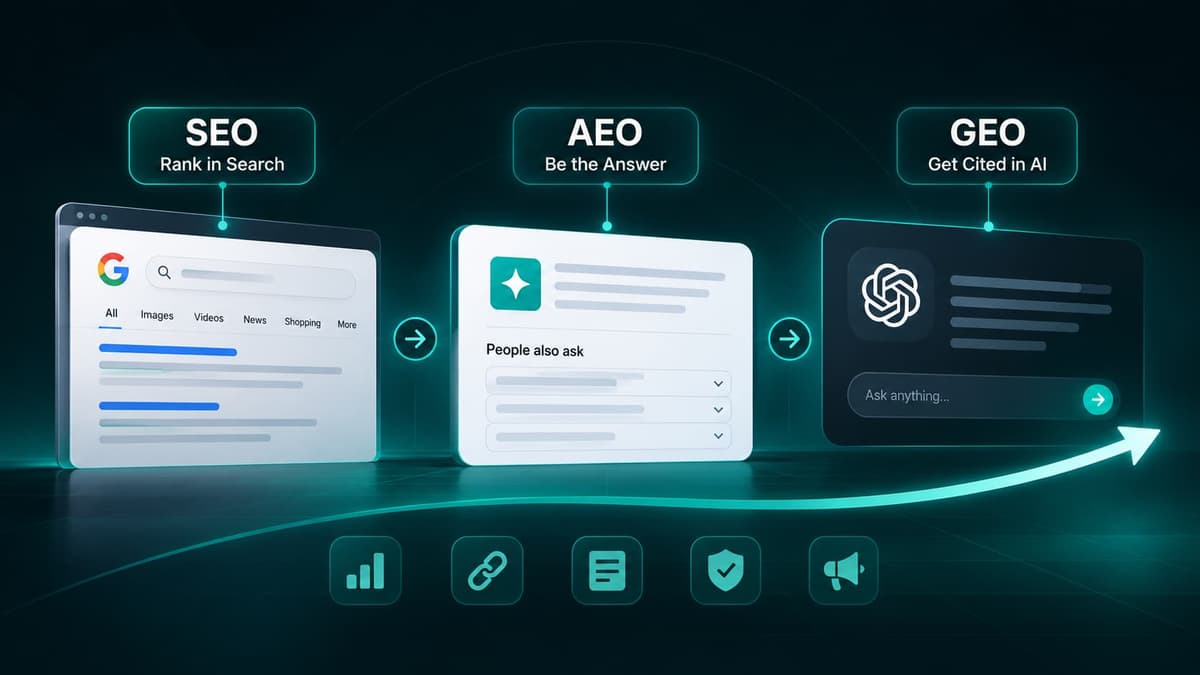
The way people discover businesses online is changing. Traditional Google searches remain important, but people are increasingly exploring products, services and brands through AI-powered experiences such as ChatGPT, Gemini and Perplexity. This shift has introduced three important concepts: Search Engine Optimization (SEO), Answer Engine Optimization (AEO) and Generative Engine Optimization (GEO). Although they have different objectives, they share a common foundation: making your brand discoverable, useful and trustworthy. In this guide, we explain how each approach works, where they overlap and how businesses can build a search visibility strategy for 2026.
What Is the Difference Between SEO, AEO and GEO?
SEO helps your website rank in traditional search results. AEO helps your content become a useful direct answer in answer-driven search experiences. GEO focuses on making your brand and information visible and citable in generative AI responses. Together, these approaches help businesses reach audiences across traditional search engines and AI-powered discovery platforms.
The three approaches are connected, but each has a different visibility objective.
| Factor | SEO | AEO | GEO |
|---|---|---|---|
| Full form | Search Engine Optimization | Answer Engine Optimization | Generative Engine Optimization |
| Primary objective | Rank web pages | Provide direct answers | Earn AI citations and brand mentions |
| Main platforms | Google, Bing | Featured snippets, voice search, AI answers | ChatGPT, Gemini, Perplexity |
| Main focus | Keywords, technical SEO, backlinks | Clear answers and content structure | Brand authority, mentions and useful sources |
| Measurement | Rankings, clicks, conversions | Answer appearances and citations | AI mentions, citations and referral traffic |
Although these terms are often discussed separately, successful search visibility requires an integrated strategy rather than three disconnected marketing campaigns.
1. What Is SEO (Search Engine Optimization)?
Search Engine Optimization is the process of improving a website so that search engines can discover, understand and rank its pages for relevant searches. When someone searches for a service such as "best digital marketing agency in India", search engines evaluate numerous signals to determine which pages are most relevant and useful. SEO helps businesses reach potential customers when they are actively looking for information, products or services.
Key Components of SEO
Technical SEO
Technical SEO ensures that search engines can crawl, render and index your website effectively. It includes website speed, mobile usability, site architecture, XML sitemaps, canonical URLs and indexability.
On-Page SEO
On-page SEO focuses on optimizing individual web pages through relevant titles, headings, content, internal links, image descriptions and search intent alignment.
Off-Page SEO
Off-page SEO builds a website's reputation through relevant backlinks, brand mentions, digital PR, industry publications and genuine third-party recommendations.
Content Marketing
Creating useful guides, industry insights, original research, comparisons and case studies helps websites address the questions their target audiences are searching for.
Why SEO Still Matters in 2026
Despite the growth of AI-powered search, SEO remains an important foundation for online discovery. Google's official guidance confirms that its AI search experiences are rooted in existing search systems and that foundational SEO practices remain relevant. Businesses should continue investing in crawlability, useful content, strong website architecture and genuine authority rather than treating AI search as a replacement for SEO.
2. What Is AEO (Answer Engine Optimization)?
Answer Engine Optimization is the process of structuring content so that search engines and answer-driven platforms can identify and present useful answers to specific questions. Instead of focusing exclusively on ranking an entire web page, AEO also focuses on making individual passages, explanations and facts easy to understand and extract.
For example, someone might search:
• What is technical SEO?
• How much does SEO cost in India?
• What is the difference between SEO and GEO?
• How can a business improve its Google rankings?
AEO helps businesses create content that addresses these questions clearly and directly.
Key AEO Strategies
1. Answer questions directly
Place a concise, accurate answer immediately after relevant question-based headings. Avoid unnecessary introductions before answering the question.
2. Use question-based headings
Use headings that reflect the actual questions customers ask. Examples include "What Is GEO?" and "How Does AEO Work?"
3. Structure information clearly
Use comparison tables, numbered steps, bullet points and descriptive headings to make complex information easier to understand.
4. Add relevant FAQs
Include genuine questions based on customer conversations, search queries and common industry problems.
5. Establish topical expertise
Publish useful supporting articles that cover related subjects in sufficient depth. Connect these articles through relevant internal links.
AEO is not simply about adding FAQ sections. It is about making information clear, accurate, accessible and useful.
3. What Is GEO (Generative Engine Optimization)?
Generative Engine Optimization focuses on improving how a brand, website or business is understood, referenced and cited in AI-generated responses. When someone asks ChatGPT, Gemini or Perplexity to recommend a marketing agency, compare software platforms or explain an industry topic, these systems may generate an answer using information from multiple sources. GEO aims to increase the likelihood that a business's relevant information becomes part of that discovery process. Unlike traditional SEO, where a user sees a list of ranked pages, generative search experiences may present summarized answers with selected citations and recommendations.
How Businesses Can Improve GEO
1. Build a consistent brand identity
Make sure your business name, services, positioning, website information and company descriptions are consistent across relevant platforms.
2. Earn relevant third-party mentions
Get your business featured in industry publications, reputable business directories, expert roundups, interviews and relevant editorial content.
4. Strengthen your digital presence
Maintain accurate business profiles, collect genuine customer reviews and build a consistent presence across relevant professional platforms.
5. Make website information accessible
Ensure that important information is available in crawlable website content and that relevant pages are not unintentionally blocked. GEO is not a guaranteed way to get a brand recommended by AI. It is an ongoing process of building discoverability, authority and reliable information across the web.
4. How SEO, AEO and GEO Work Together
SEO, AEO and GEO should not be treated as competing marketing strategies. They support different stages of online discovery. Consider a business searching for a digital marketing partner. First, it may use Google to find agencies. SEO helps relevant agency websites appear in those search results. Next, it may ask Google or an AI assistant questions about choosing an agency. AEO helps the agency publish clear and useful answers. Finally, it may ask ChatGPT or Perplexity to recommend suitable agencies. GEO focuses on building the brand's credibility and visibility across relevant information sources. An integrated strategy allows businesses to build visibility across these different experiences.
A Practical Example
Imagine a company offering digital marketing services.
| Business activity | SEO contribution | AEO contribution | GEO contribution |
|---|---|---|---|
| Publishing a service guide | Targets relevant searches | Answers customer questions | Provides useful information for AI systems |
| Creating comparison pages | Captures comparison keywords | Structures differences clearly | Helps establish topical relevance |
| Earning industry backlinks | Builds page authority | Supports source credibility | Creates third-party brand references |
| Publishing case studies | Attracts relevant searches | Explains processes and outcomes | Provides verifiable brand evidence |
| Building brand profiles | Improves discoverability | Clarifies business information | Strengthens entity consistency |
The objective is not to publish three versions of the same article. It is to create one useful resource that performs well across multiple discovery experiences.
5. The Role of Backlinks and Brand Mentions in Modern Search
Backlinks remain an important part of SEO because they help search engines discover pages and understand how websites are connected. However, not every backlink provides the same value. A contextual link from a relevant industry publication can be more valuable than multiple links from unrelated websites created purely for SEO. For businesses investing in SEO and GEO, link building should focus on both website authority and genuine brand visibility.
Backlink Strategies Businesses Should Prioritize
Guest Contributions
Contribute original, useful articles to relevant marketing, technology and business publications. Include a contextual link where it genuinely adds value and the publisher permits it.
Digital PR
Share original research, expert commentary, industry insights and useful findings with journalists and publishers.
Industry Directories
Build complete and accurate profiles on reputable agency directories, professional platforms and relevant business listings.
Resource Page Link Building
Identify websites that maintain useful marketing resources, agency lists and industry guides. Suggest relevant resources from your website when they genuinely improve the page.
Broken Link Building
Find broken external links on relevant websites and suggest a suitable, existing resource from your website as a replacement.
Expert Contributions
Provide useful answers, expert commentary and original insights to journalists, editors and industry publications.
What Makes a Quality Backlink?
Evaluate potential links using these factors:
• Relevance to your business and industry.
• Editorial quality of the referring website.
• Real readership and organic visibility.
• Context in which your website is mentioned.
• Whether the link provides genuine value to readers.
• Natural anchor text and appropriate link attributes.
Avoid buying bulk backlinks, participating in private blog networks or using automated link-building schemes. These shortcuts can create long-term search risks.
6. A 90-Day SEO, AEO and GEO Strategy for Businesses
An effective search visibility strategy needs a clear execution plan. Businesses should prioritize technical foundations, useful content and authority building before expecting meaningful results. Here is a practical 90-day framework.
Days 1–30: Build the Foundation
Focus on understanding the current website and identifying the biggest opportunities. Key activities:
• Conduct a technical SEO audit.
• Review indexing and crawlability.
• Research keywords and search intent.
• Analyze competitor content.
• Improve important service pages.
• Review internal linking.
• Establish a baseline for organic traffic and AI visibility.
Expected output: A prioritized SEO and content roadmap.
Days 61–90: Expand Visibility and Measure Results
Use performance data to identify which strategies are working. Key activities:
• Review keyword rankings and organic clicks.
• Identify pages gaining impressions.
• Improve pages with weak click-through rates.
• Track brand mentions in AI-generated answers.
• Review referring domains and acquired backlinks.
• Identify new content opportunities.
• Update older resources where information has changed.
Expected output: A measurable search visibility programme with clear next steps. A 90-day plan is an execution framework, not a guarantee of rankings or AI citations within that period.
7. How to Measure SEO, AEO and GEO Performance
A search visibility strategy should be evaluated through meaningful business outcomes rather than the number of published articles or backlinks alone.
| Metric | What It Measures | Useful Tools |
|---|---|---|
| Organic clicks | Visits from search results | Google Search Console |
| Keyword positions | Ranking performance | Ahrefs, Semrush |
| Organic sessions | Search-driven website traffic | Google Analytics 4 |
| Referring domains | Websites linking to your domain | Ahrefs, Semrush |
| AI referral traffic | Visits from AI platforms | Google Analytics 4 |
| AI brand mentions | Brand visibility in AI responses | Manual prompt tracking and specialist tools |
| Conversions | Leads and enquiries generated | GA4 and CRM |
For AI visibility, track a consistent set of buyer-intent questions across ChatGPT, Gemini and Perplexity. Record whether your brand appears, which pages are cited and how your business is described. Do not treat a brand mention as equivalent to a website visit or a conversion. Each metric represents a different stage of discovery.
8. Common SEO, AEO and GEO Mistakes to Avoid
Businesses often make mistakes when they try to optimize for every new search trend at once. Here are some common problems:
Treating GEO as a replacement for SEO
Technical SEO, relevant content and website authority remain essential foundations.
Publishing generic AI-generated articles
Content that simply repeats information available on hundreds of websites provides little additional value. Add original experience, analysis, examples and evidence.
Building irrelevant backlinks
Large numbers of unrelated or low-quality backlinks do not automatically improve rankings or brand credibility.
Ignoring brand consistency
Inconsistent business descriptions, services and company information can make it harder for people and platforms to understand what a business actually offers.
Focusing only on rankings
Rankings are useful, but businesses should also measure traffic quality, engagement, enquiries and conversions.
Expecting guaranteed AI recommendations
No agency can legitimately guarantee that ChatGPT, Gemini or another AI platform will recommend a specific business for every relevant prompt.
9. Frequently Asked Questions
What is the main difference between SEO, AEO and GEO?
SEO focuses on ranking web pages in search results. AEO focuses on making information easy to extract as direct answers. GEO focuses on improving brand and content visibility in generative AI responses.
Is SEO still important with the growth of AI search?
Yes. Search engines continue to use established crawling, indexing, relevance and quality systems. Strong SEO fundamentals also support visibility across many AI-powered search experiences.
Does AEO replace traditional SEO?
No. AEO complements SEO by making useful information easier to identify and present in answer-driven experiences.
How can a business appear in ChatGPT recommendations?
Build a credible online presence, publish useful and accurate content, earn relevant third-party coverage, maintain consistent business information and ensure your website is accessible to relevant crawlers. None of these guarantees a recommendation.
Are backlinks important for GEO?
Relevant third-party references can help establish brand credibility and create additional discovery opportunities. However, there is no guaranteed backlink formula for AI citations.
How long does SEO and GEO take to show results?
Timelines vary according to competition, website condition, existing authority, content quality and the effort invested. SEO improvements may take several months, while AI visibility can fluctuate as platforms and retrieval systems change.
Should small businesses invest in SEO, AEO and GEO together?
Small businesses should start with technical SEO, useful website content and accurate business information. They can then improve answer-oriented content and invest in relevant third-party visibility as resources allow.
Conclusion: Build a Search Strategy for the Way People Discover Businesses
Search is evolving, but the fundamentals of being discoverable have not disappeared. SEO helps businesses earn visibility in traditional search results. AEO makes their information easier to use in answer-driven experiences. GEO helps strengthen their presence in generative AI discovery. The most effective approach is to combine all three through useful content, a technically sound website, consistent brand information and genuine authority. At Garage Collective, we believe modern digital growth requires more than chasing rankings. Businesses need a connected strategy that brings together search visibility, creative content, performance marketing and brand authority. Want to improve your brand's visibility across Google and AI-powered search? Explore Garage Collective's digital growth services at https://garagecollective.agency/ and start building a search strategy designed for the way people discover businesses today.
• Google Search Central – AI Features and Your Website
Like what you're reading?
Get a free marketing plan tailored to your brand
Get Your Free Planyes, actually free. we're not kidding.
Key Takeaways
- SEO remains the foundation of online visibility: It helps businesses improve search rankings, attract organic traffic and reach potential customers.
- AEO makes content answer-ready: Clear explanations, question-based headings and structured information help search and answer engines understand your content.
- GEO strengthens AI search visibility: Consistent brand information, authoritative content and relevant third-party mentions can improve your chances of being referenced in AI-generated answers.
- Backlinks and brand mentions matter: Relevant editorial links, digital PR and industry publications help build online authority and brand recognition.
- SEO, AEO and GEO work best together: An integrated strategy helps businesses become discoverable across traditional search engines and AI-powered platforms.
- Quality content beats content volume: Original insights, useful guides, credible information and real expertise create more value than publishing generic articles.
- Measure what drives business growth: Track organic traffic, keyword rankings, referring domains, AI citations, referral visits and conversions to understand performance.
the TL;DR your boss will love
This Isn't Just Theory. We Do This Daily.
Let us show you exactly what we'd do for your brand - strategy, channels, budget, timeline. Free. No pitch deck.
Get Smarter Every Week
Ideas, data, and the occasional hot take. Biweekly, no spam.
we promise not to sell your email to robots
You Might Also Dig These
^ we picked these just for you (okay, the algorithm did)
Google's October 2026 AI Content Guidance: SEO and E-E-A-T Checklist
Google updated its guidance on generative AI content on 1 October 2026, aligning the documentation more closely with its Search Quality Rater Guidelines. The update does not create a special ranking system for AI-written pages. It sharpens the standard that matters: content should serve a clear audience, demonstrate real expertise and make factual claims easy to verify. For Indian marketing teams using AI at scale, the operational question is no longer whether AI may be used. It is whether every published page adds original value, accountable authorship and dependable evidence.
ReadIndia Festive Commerce Playbook 2026: D2C, Quick Commerce and Always-On Growth
India’s festive season remains a major commercial opportunity, but e-commerce demand is no longer limited to a few sale events. NIQ describes a market shaped by both habitual purchases and event-driven peaks, while Meta points to video-first discovery, creators and messaging-led commerce. A useful festive plan connects demand forecasting, channel roles, creative and customer experience from discovery through repeat purchase.
ReadUltimate Guide to AI-First Agency Month: Optimize Performance Marketing ROI Amid Rising Ad Costs in India
Struggling to keep up with rising ad costs and ever-changing Google and Meta algorithms? Indian marketers, startups, and D2C brands are feeling the pressure to scale smarter - not harder. Ready to cut through the noise and supercharge your performance marketing ROI? This guide reveals AI-first strategies, proprietary tools, and proven tactics to help you stay ahead and win big in India’s digital market.
Read