Internal Linking in 2026: Find and Fix Orphan Pages
Ammar
AI Specialist
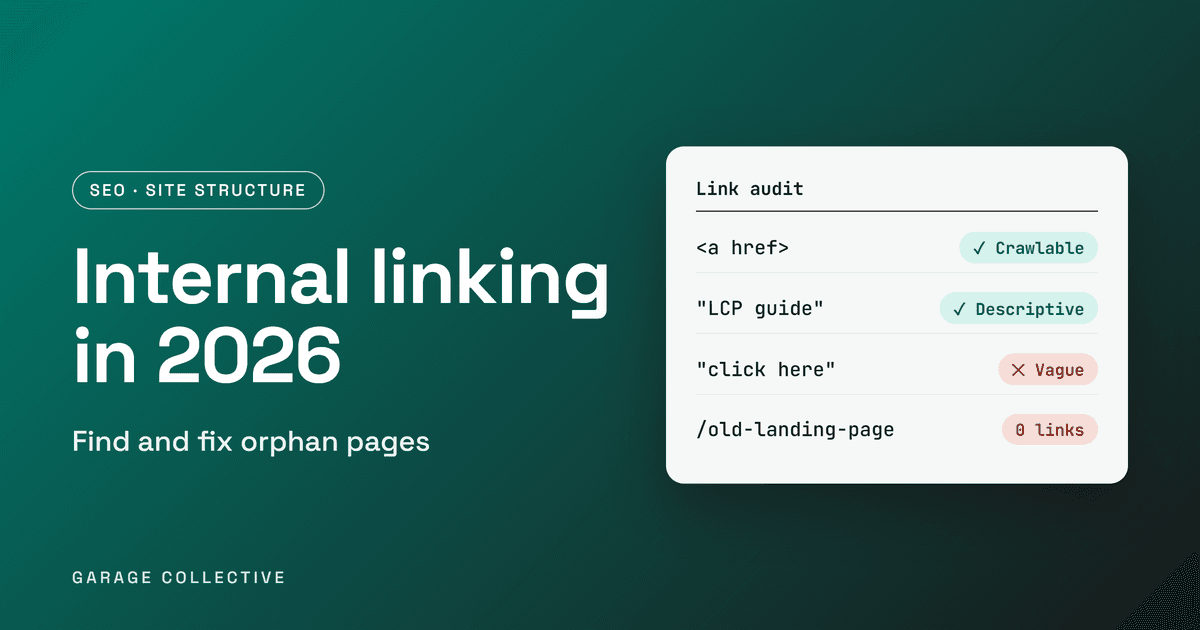
Google's guidance on links includes a line that sounds almost too simple: every page you want indexed should receive at least one link from another page on your site. Most blogs break that rule without noticing. A post goes live, the sitemap picks it up, the team celebrates, and nothing on the site actually points to it. This guide is a practical internal linking audit: how to find the pages nobody links to, how to write anchor text a stranger could understand, and how to check that your links are real links in the first place. It is built on Google's own link best practices, plus a few editorial rules of thumb.
What internal links actually do
Internal links do two jobs. They give crawlers a path to your pages, and their anchor text tells Google and readers what the page on the other end is about. Google's guidance is clear on the first job: a page you want indexed needs at least one link pointing to it from another page on your site. Without that link, the page is an orphan, and a sitemap entry alone is a thin way to get it found. Any crawler that finds pages by following links, AI crawlers included, needs a path in the same way.
Rule one: use real links
Google generally follows only elements that have an href attribute. Extra attributes such as onclick or class do not stop crawling, and links that JavaScript inserts work if they use the same markup. The href should hold a real URL that resolves.
Core Web Vitals guide Core Web Vitals guide Core Web Vitals guide Core Web Vitals guide
Google may still parse some of the broken forms, but it calls them unreliable. If your menu, cards or buttons are built from scripts, spot-check that the rendered HTML contains a proper .
Rule two: anchor text a stranger could understand
Google's test is simple: read the anchor text on its own. If it does not tell you where the link goes, it needs more detail. Good anchor text is descriptive, reasonably concise, and relevant to both the page it sits on and the page it points to.
| Weak anchor | Better anchor | Why |
|---|---|---|
| click here | how to pass LCP, INP and CLS | Names the destination |
| read more | robots.txt rules for AI crawlers | Google lists "read more" as too generic |
| our guide | llms.txt explained | Tells the reader what they get |
| SEO SEO audit SEO checklist India | SEO audit checklist | Keyword stuffing, which Google tells you to avoid |
Three smaller points from the same guidance. Link text goes between the tags, because an empty link is a bad practice. For an image that works as a link, Google uses the image's alt text as the anchor, so write a descriptive one. And spread links across sentences with some explanation between them instead of stringing single-word links together.
Rule three: no orphan pages
An orphan page is a page nothing else on your site links to. They are easy to create: a landing page built for a campaign, an old post after a redesign, a new article nobody remembered to link. The fix is a short list.
• Export every URL from your XML sitemap.
• Crawl the site from the homepage with any crawler and export every URL it reaches by following links.
• Compare the two lists. Any URL in the sitemap but not in the crawl is an orphan.
• For each one, decide: link it from a relevant page, or remove it.
Link where it helps the reader
Google's advice is to link to related pages in context, where the link helps a reader understand the topic. It does not set a number, but it does say a page with too many links probably has too many. Our rule of thumb, not Google's: if a link would not make a reader think "yes, I wanted that next", leave it out. A footer stuffed with 80 links is not a strategy.
A simple link map for a topic cluster
A cluster is a group of posts on one subject that point at each other. Take technical SEO on our own blog. These posts already exist: robots.txt for AI crawlers, Core Web Vitals in 2026, llms.txt explained, the CSS-generated content indexing audit and enterprise website architecture for search and AI. Here is the shape we would aim for. It is an editorial model, not a Google requirement.
| Page type | Links out to | Should receive links from |
|---|---|---|
| Hub page for the topic | Every post in the cluster | Main navigation, homepage, related service page |
| Cluster post | The hub, plus 1 or 2 closely related posts | The hub, plus related posts |
| Service or landing page | The cluster posts that prove the claim | Cluster posts where the service is relevant |
JavaScript sites: check the rendered links
If links or their anchor text are inserted by JavaScript, Google says to confirm that they appear in the rendered HTML, and it points to the URL Inspection Tool for that check. Framework-specific attributes such as routerLink are on its not-recommended list, so make sure the final output is a normal .
A 45-minute internal link audit
• Run the sitemap versus crawl comparison above and list your orphan pages.
• Search your crawl export for anchors like "click here", "read more" and "learn more", and rewrite the ones on important pages.
• Find image links with empty alt text and fix them.
• Open your five most important pages and count the links pointing to them. If a money page has fewer links than an old blog post, change that.
• Check that menus and cards use real links in the rendered HTML.
• For each new post you publish, add links to it from two or three older, related posts the same day.
FAQ
How many internal links should a page have?
Google does not give a number. It says to link to related pages where they help the reader, and that a page with too many links probably has too many.
What counts as an orphan page?
A page that no other page on your site links to. Google's guidance says every page you want indexed should get at least one link from another page on your site.
Does "click here" anchor text hurt?
It wastes the chance to describe the destination. Google lists "click here" and "read more" as too generic and suggests anchor text that tells you where the link goes.
Should I stuff keywords into anchor text?
No. Google says to write anchor text naturally and keep only the terms a reader needs.
Do images work as internal links?
Yes, but Google uses the image's alt text as the anchor text. Empty alt text on a linked image is a bad practice, so write a descriptive one.
Sources:
Like what you're reading?
Get a free marketing plan tailored to your brand
Get Your Free Planyes, actually free. we're not kidding.
Key Takeaways
- Every page you want indexed needs at least one internal link from another page on your site.
- Use real links. Click handlers, span tags and javascript: URLs are not recommended.
- Write anchor text that explains the destination on its own, and never stuff it with keywords.
- Compare your sitemap against a crawl to find orphan pages, then link them or remove them.
- Link where it helps the reader, and add links to every new post from two or three older ones the day you publish.
the TL;DR your boss will love
This Isn't Just Theory. We Do This Daily.
Let us show you exactly what we'd do for your brand - strategy, channels, budget, timeline. Free. No pitch deck.
Get Smarter Every Week
Ideas, data, and the occasional hot take. Biweekly, no spam.
we promise not to sell your email to robots
You Might Also Dig These
^ we picked these just for you (okay, the algorithm did)
Google's October 2026 AI Content Guidance: SEO and E-E-A-T Checklist
Google updated its guidance on generative AI content on 1 October 2026, aligning the documentation more closely with its Search Quality Rater Guidelines. The update does not create a special ranking system for AI-written pages. It sharpens the standard that matters: content should serve a clear audience, demonstrate real expertise and make factual claims easy to verify. For Indian marketing teams using AI at scale, the operational question is no longer whether AI may be used. It is whether every published page adds original value, accountable authorship and dependable evidence.
ReadIndia Festive Commerce Playbook 2026: D2C, Quick Commerce and Always-On Growth
India’s festive season remains a major commercial opportunity, but e-commerce demand is no longer limited to a few sale events. NIQ describes a market shaped by both habitual purchases and event-driven peaks, while Meta points to video-first discovery, creators and messaging-led commerce. A useful festive plan connects demand forecasting, channel roles, creative and customer experience from discovery through repeat purchase.
ReadUltimate Guide to AI-First Agency Month: Optimize Performance Marketing ROI Amid Rising Ad Costs in India
Struggling to keep up with rising ad costs and ever-changing Google and Meta algorithms? Indian marketers, startups, and D2C brands are feeling the pressure to scale smarter - not harder. Ready to cut through the noise and supercharge your performance marketing ROI? This guide reveals AI-first strategies, proprietary tools, and proven tactics to help you stay ahead and win big in India’s digital market.
Read